logo elektroda
logo elektroda
X
logo elektroda
Dostępna jest polska wersja

Czy wolisz polską wersję strony elektroda?

Nie, dziękuję Przekieruj mnie tam

BSIDE ESR02 Pro tester, comparison of measurements with ESR70 and LCR-T4

p.kaczmarek2 5850 6

TL;DR

  • BSIDE ESR02 Pro component tester is compared against the LCR-T4, ESR70, and sometimes a Brymen BM857S multimeter.
  • Inside, it uses an Atmega328P, an AMS1117 3.3V LDO, and an LM393 comparator.
  • The tester costs less than PLN 100 and arrived without a battery, so calibration and a good supply cell were necessary.
  • In tests, ESR02 often failed on BD140, BC557, IRF510, 22uH and 220uH chokes, 0.22 ohm resistors, and IRFP460.
  • The conclusion is disappointing: it looks like a clone of the LCR-T4, but performs worse and may need a firmware change.
Generated by the language model.
ADVERTISEMENT
Treść została przetłumaczona polish » english Zobacz oryginalną wersję tematu
📢 Listen (AI):
  • BSIDE ESR02 Pro component tester displaying capacitor measurement results.
    I invite you to a short comparison (gallery) of the BSIDE ESR02 Pro component tester. I will compare its results here to the classical ones LCR-T4 , known from the elektroda shop, to the previously described ESR70 , and in some cases to the results shown by the Brymen BM857S multimeter.

    Purchase BSIDE ESR02 Pro
    The prices of this tester vary, in our country you can get it for less than PLN 100, but if you import it from China it may be cheaper. In this case, my friend bought the tester, he was convinced by the promising advertising of its capabilities, but what is it really like?
    I took the tester with me because I had something to compare it with.
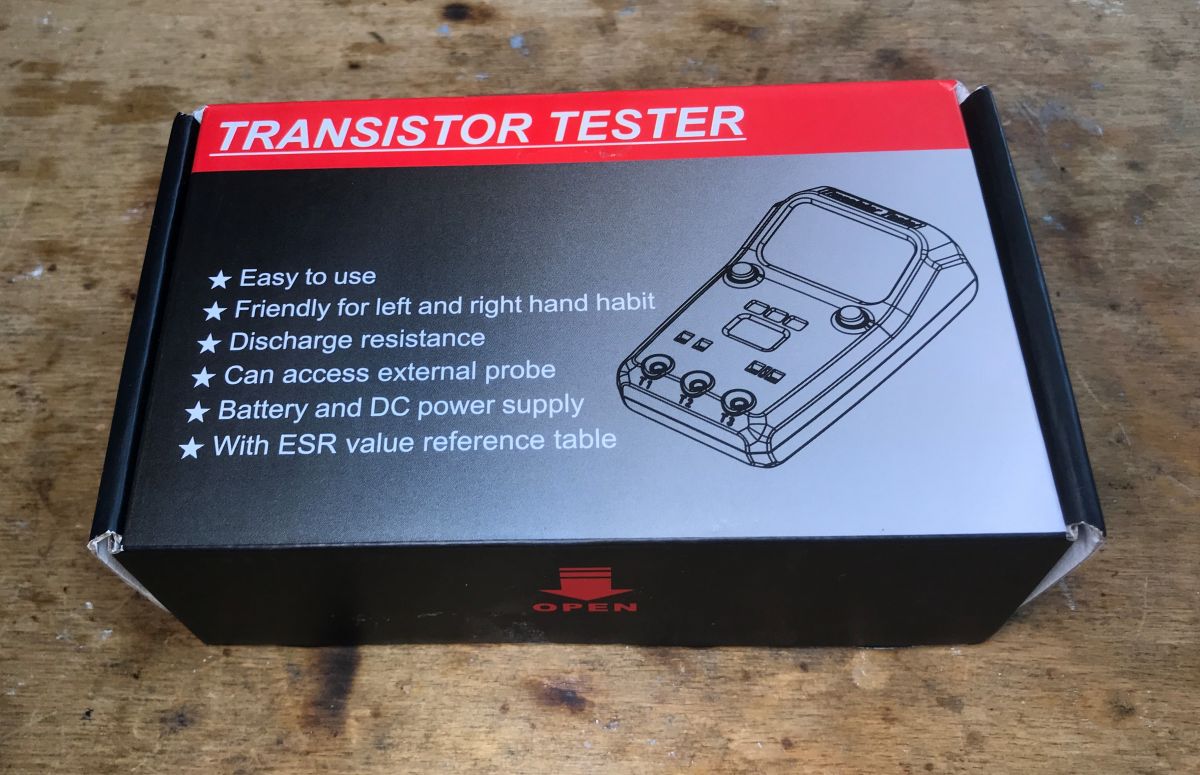
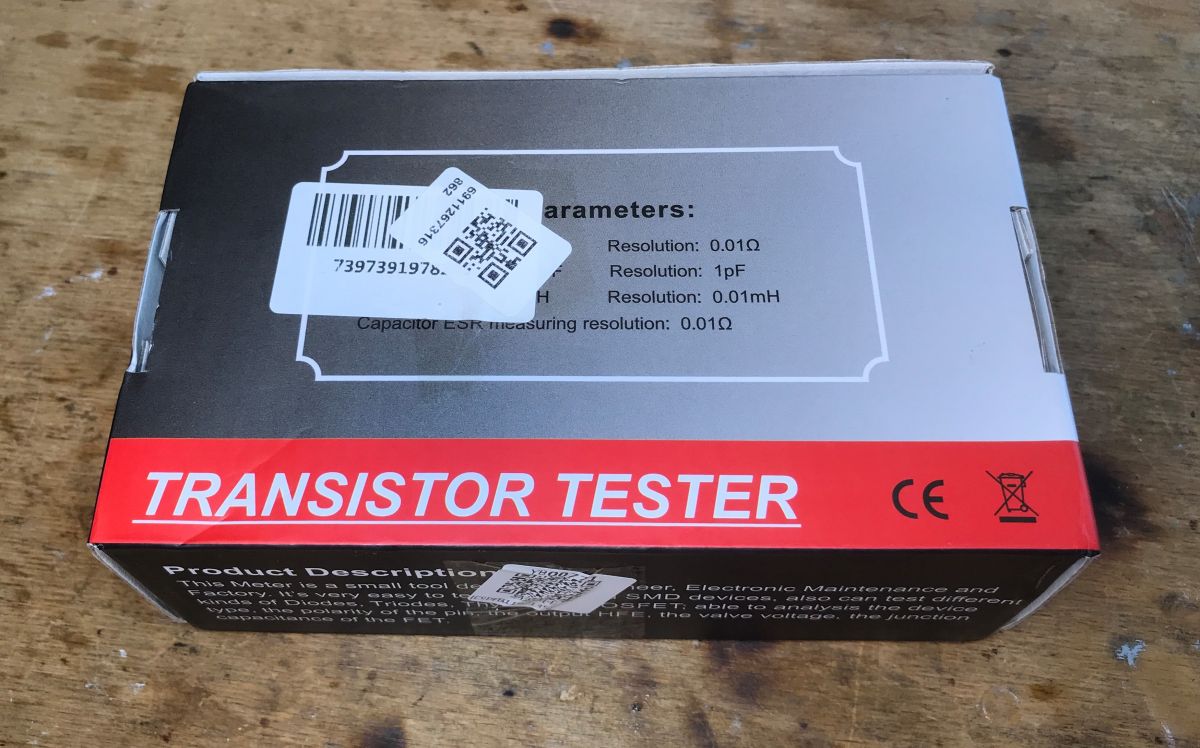
    The tester comes in a box:
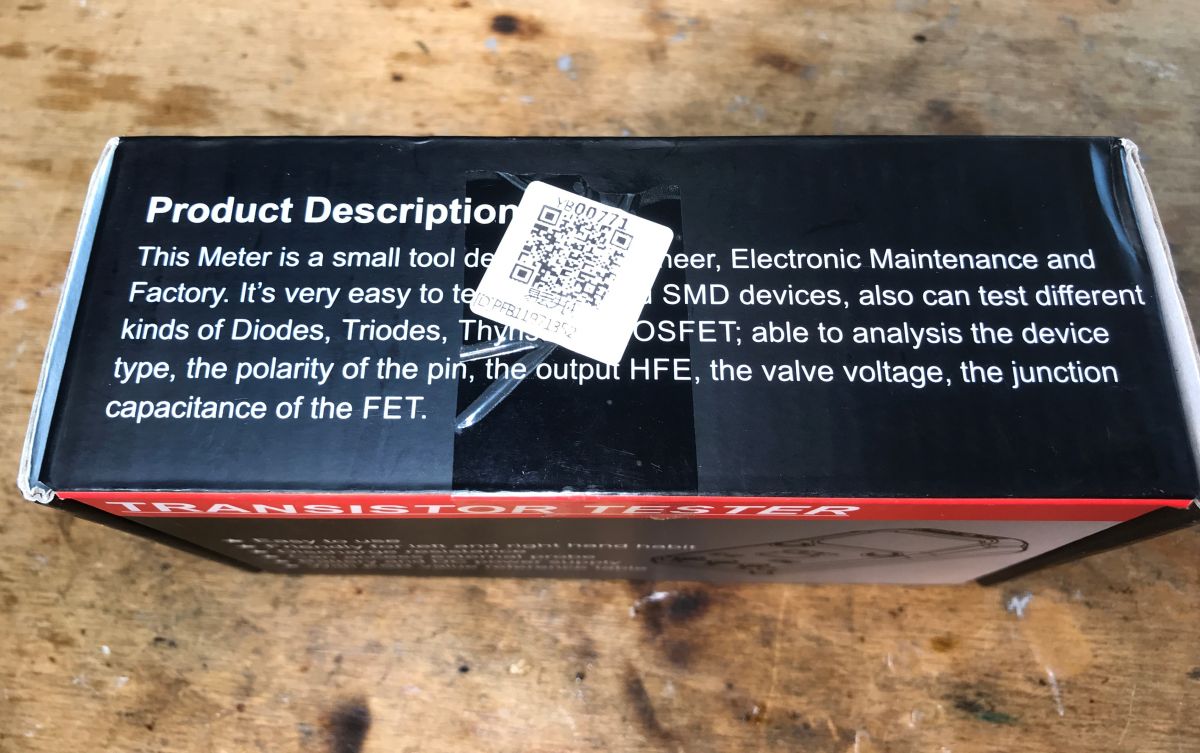
    Box of the BSIDE ESR02 Pro component tester with product description. Box of BSIDE ESR02 Pro transistor tester. Box of the BSIDE ESR02 Pro transistor tester on a wooden table.
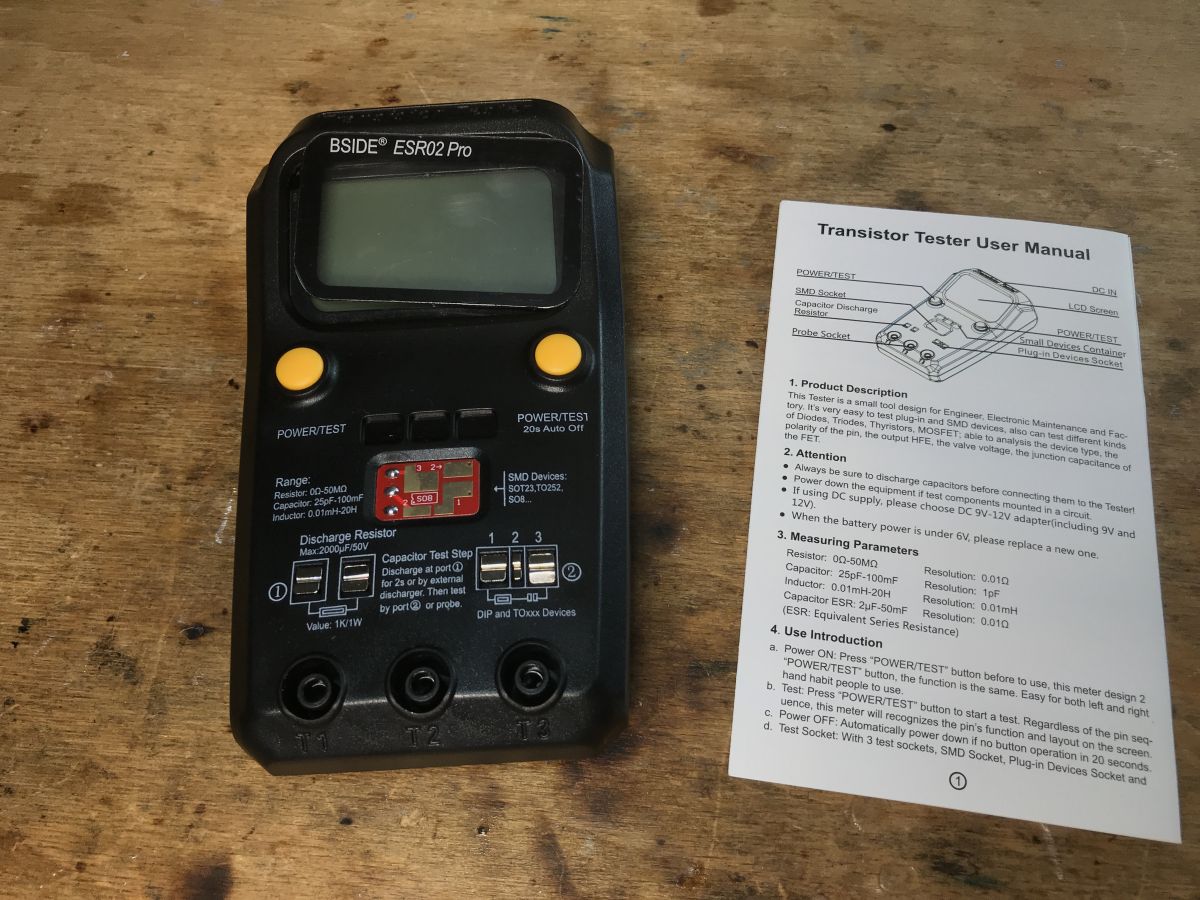
    There is also an instruction manual with the procedure calibration : :
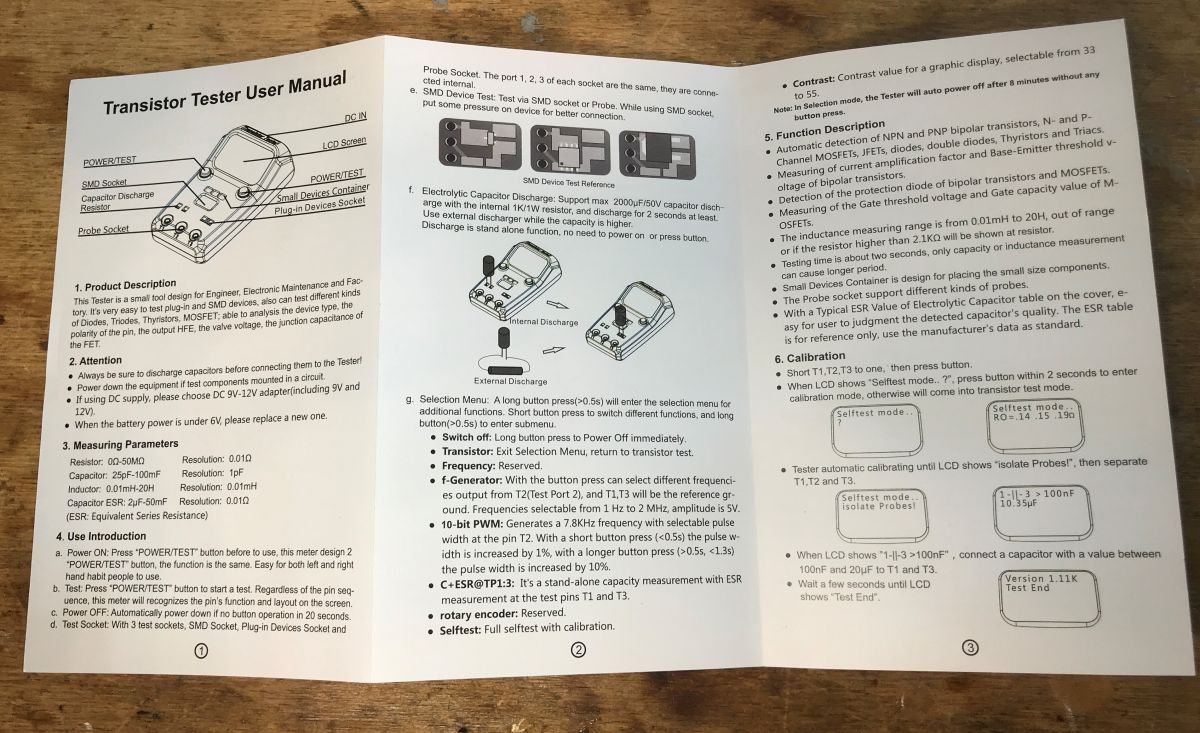
    Transistor tester user manual.
    I don`t know why the tester arrived in such a condition:
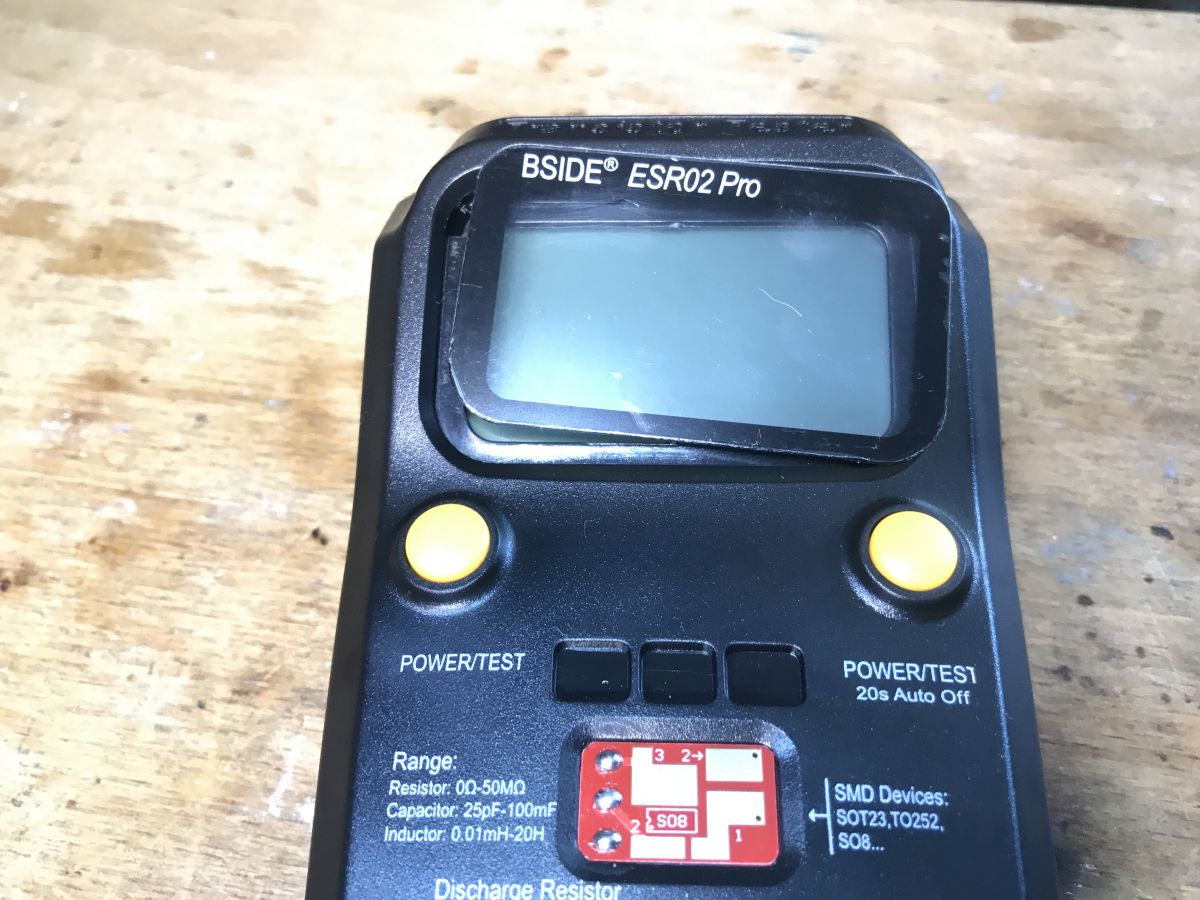
    BSIDE ESR02 Pro component tester on a wooden table. BSIDE ESR02 Pro component tester with user manual.
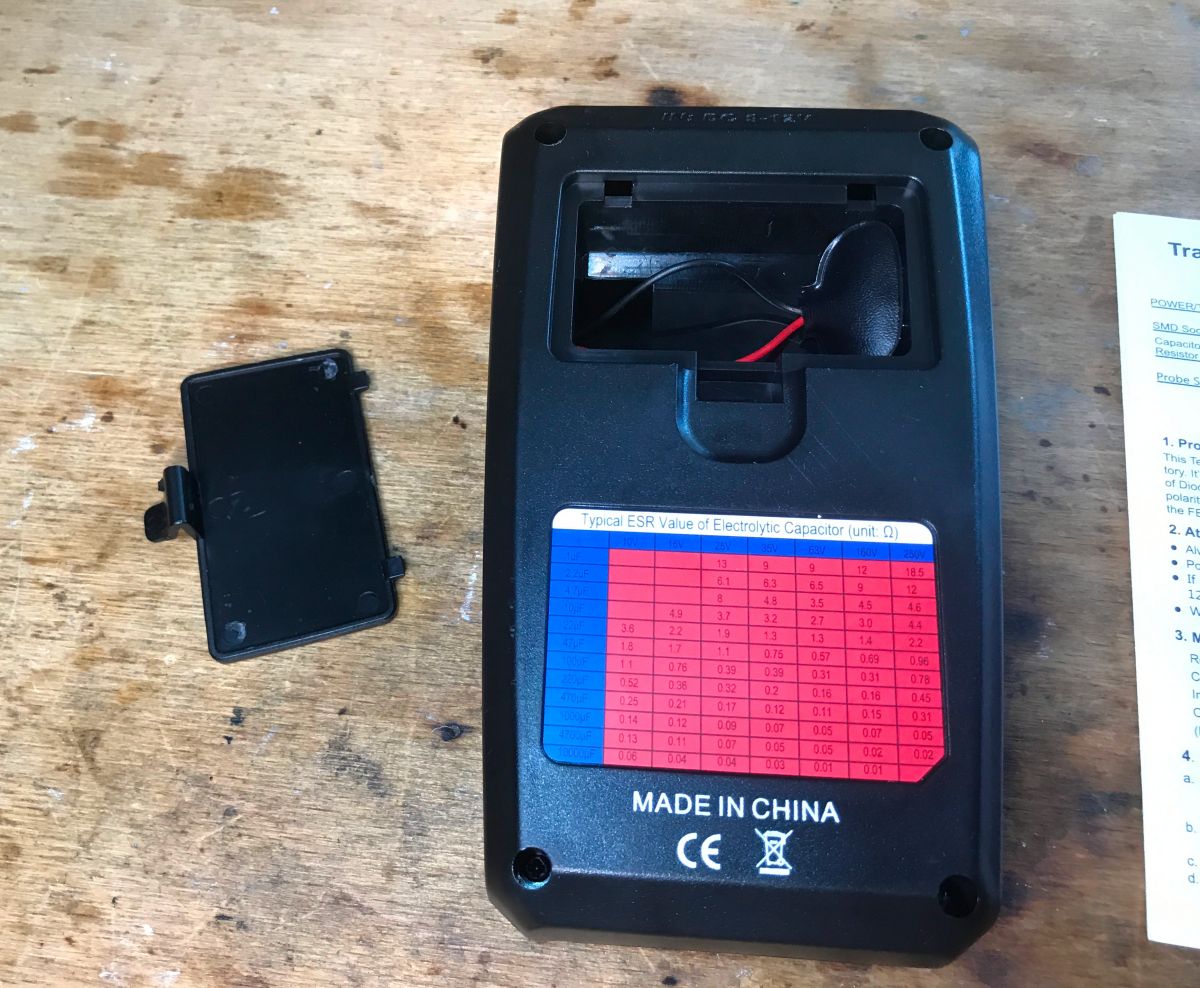
    The battery is not included, there is an ESR table on the back:
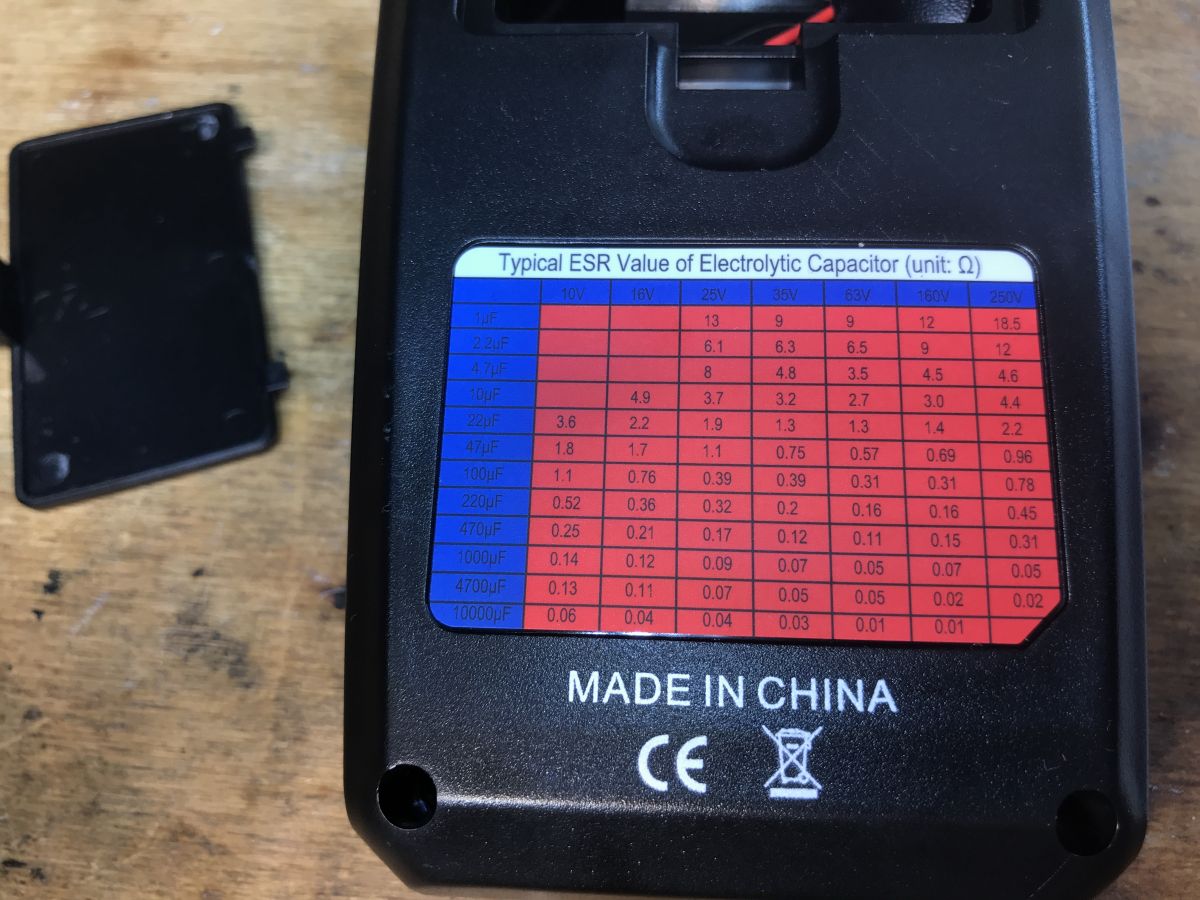
    Back of BSIDE ESR02 Pro tester case with ESR value chart. Back of the BSIDE ESR02 Pro component tester with an open battery compartment.
    You need to give it a good battery, otherwise it may not turn on:


    Fortunately, I have a stock of them:
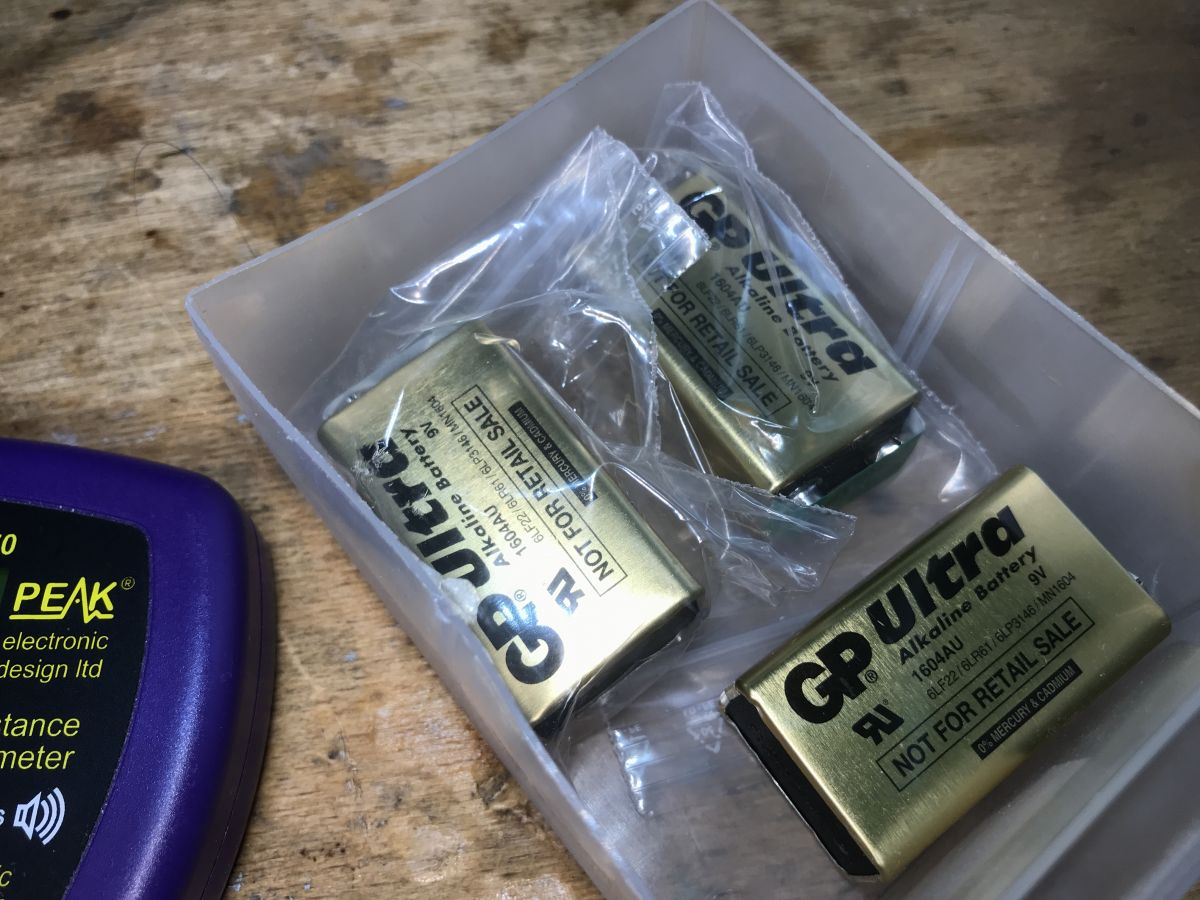
    GP Ultra 9V batteries in a plastic box next to a measuring device.
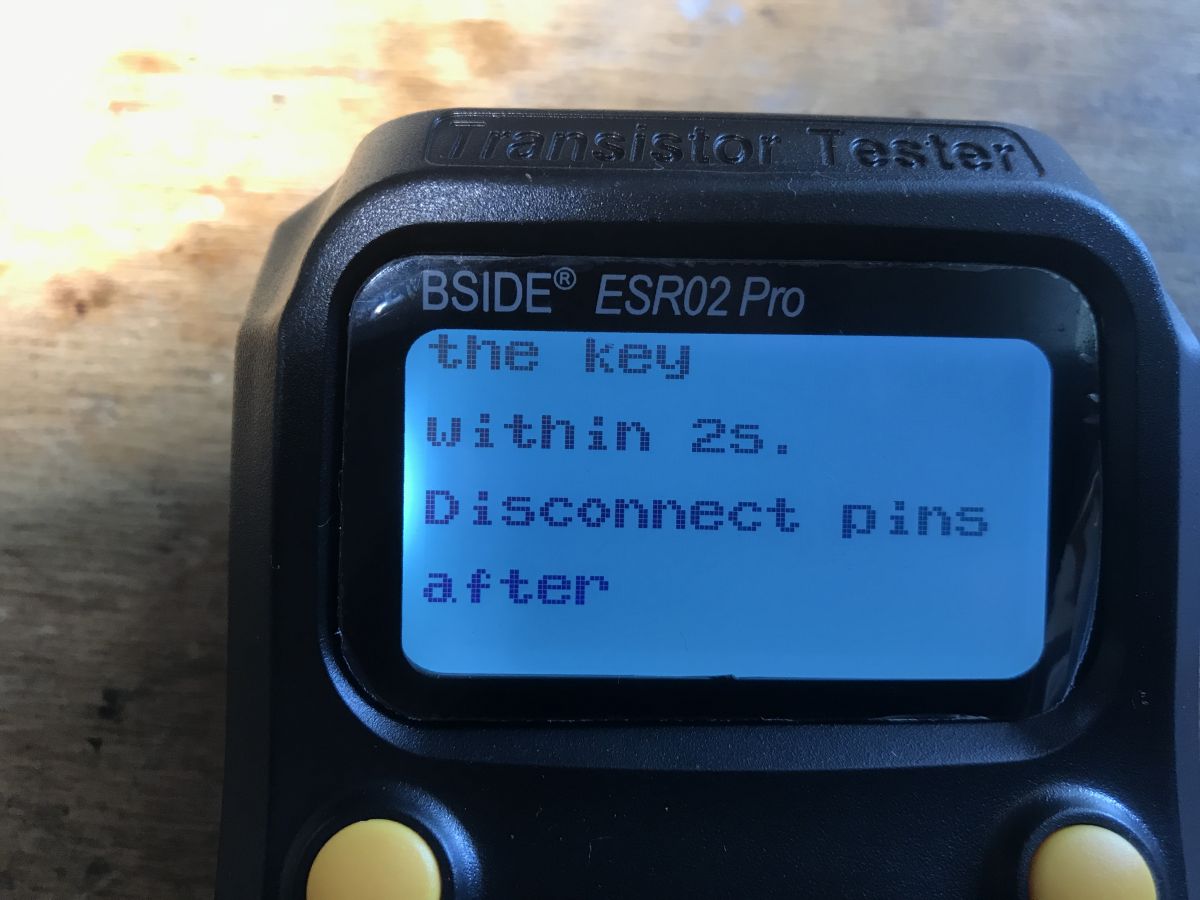
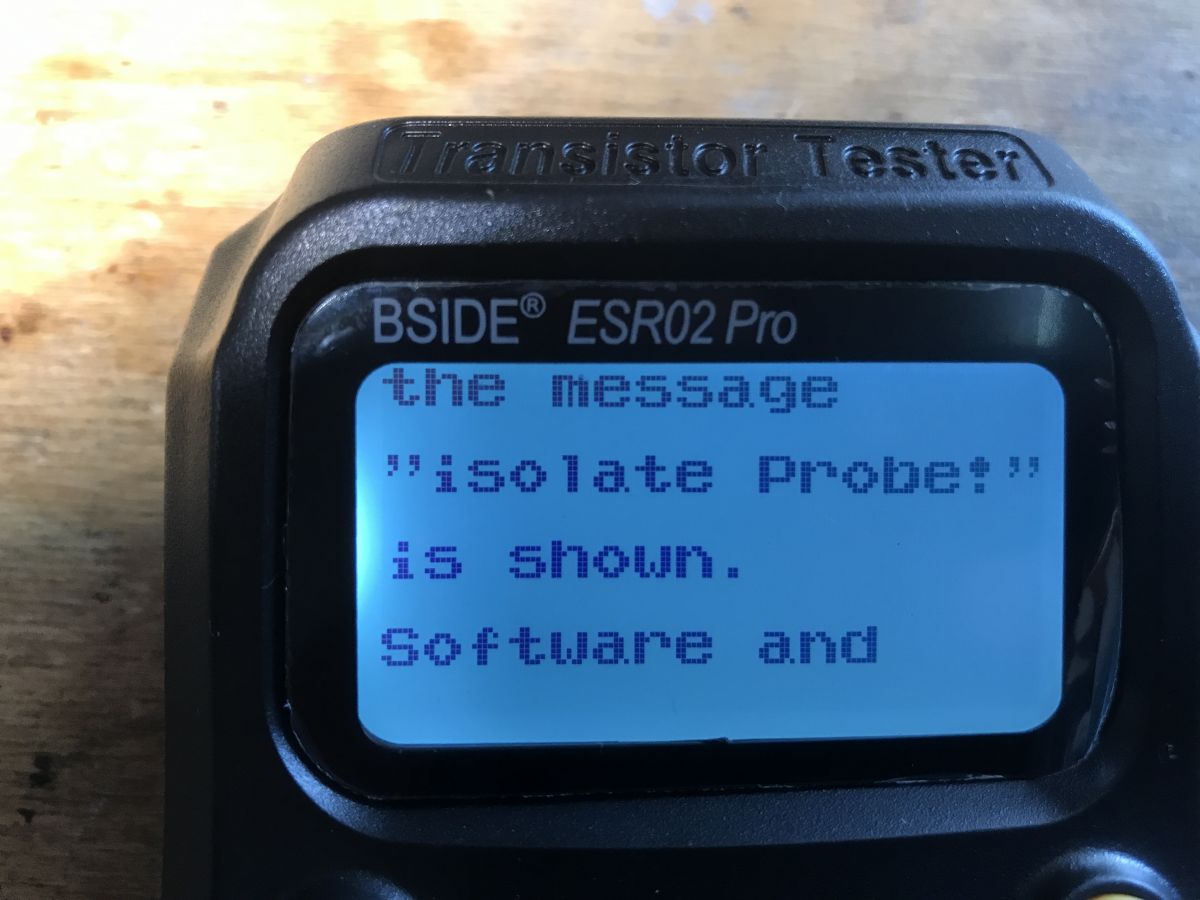
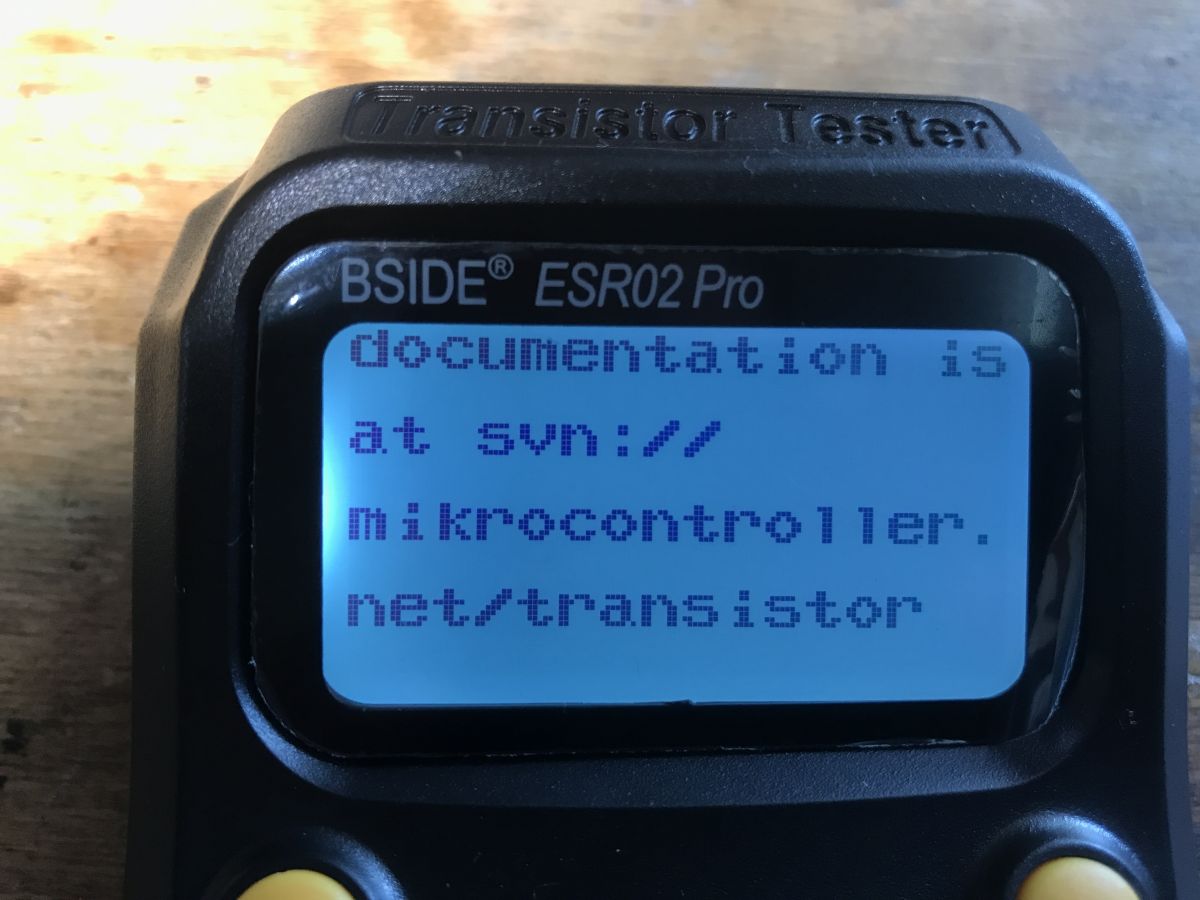
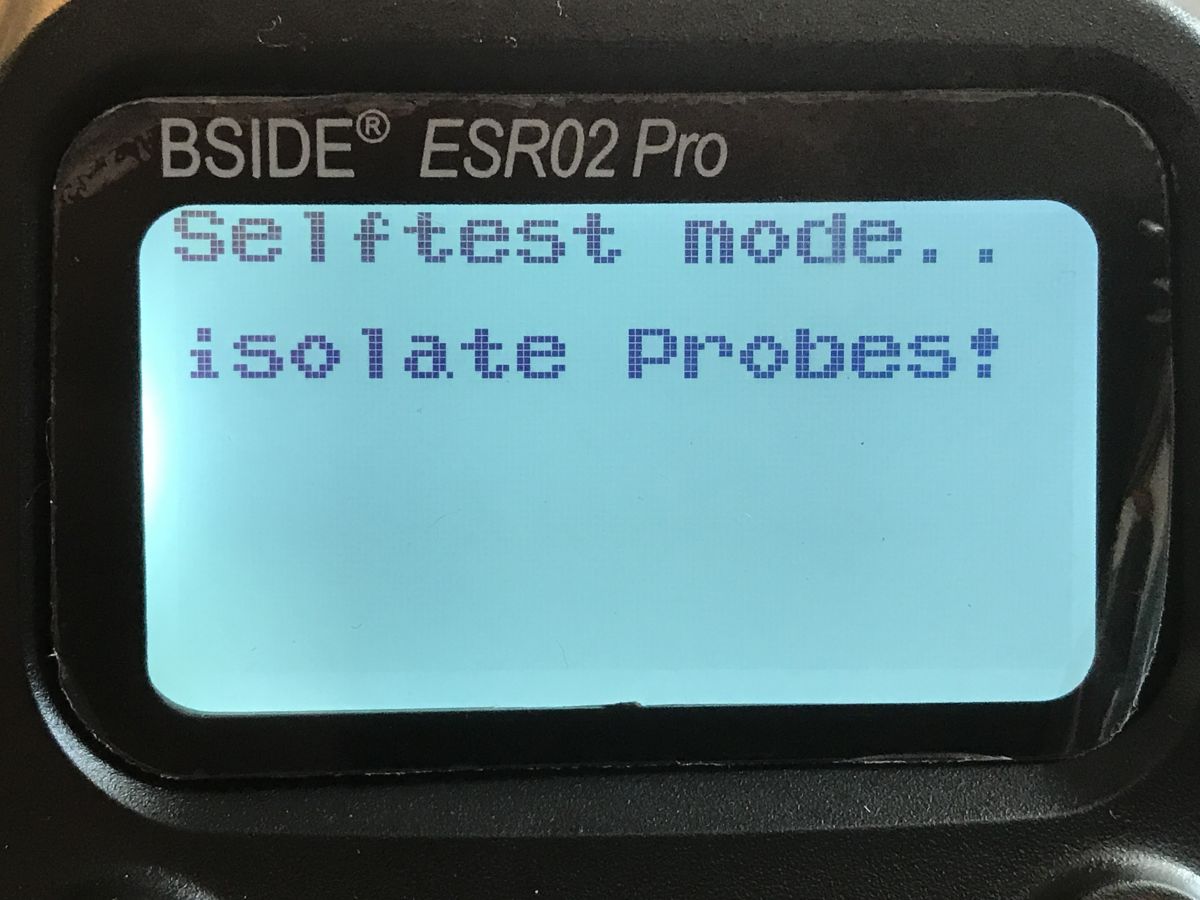
    I also performed calibration:
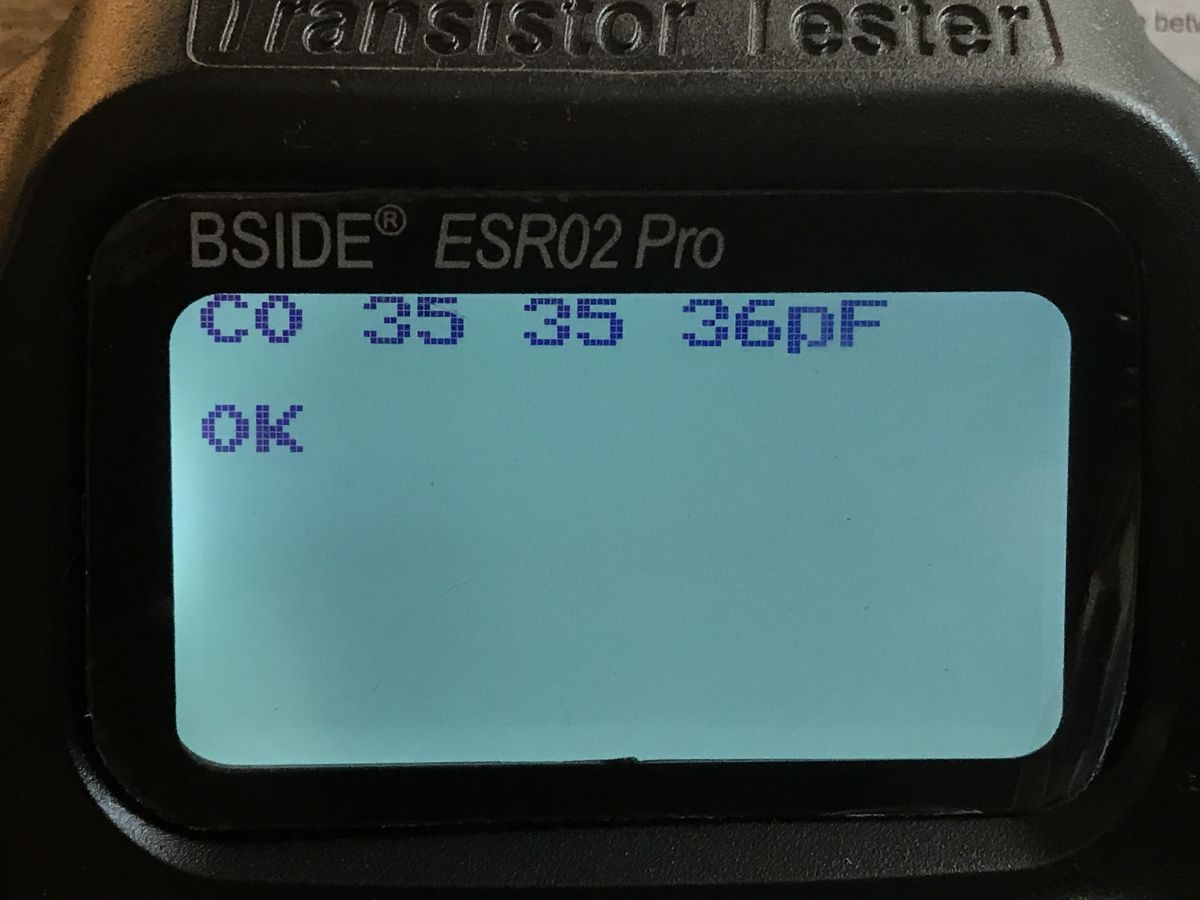
    Display of the BSIDE ESR02 Pro component tester with a calibration message. Display of BSIDE ESR02 Pro tester with a calibration message. BSIDE ESR02 Pro component tester with text displayed. BSIDE ESR02 Pro display in self-test mode. View of the BSIDE ESR02 Pro tester screen displaying capacitance measurements.
    After calibration, we start testing:
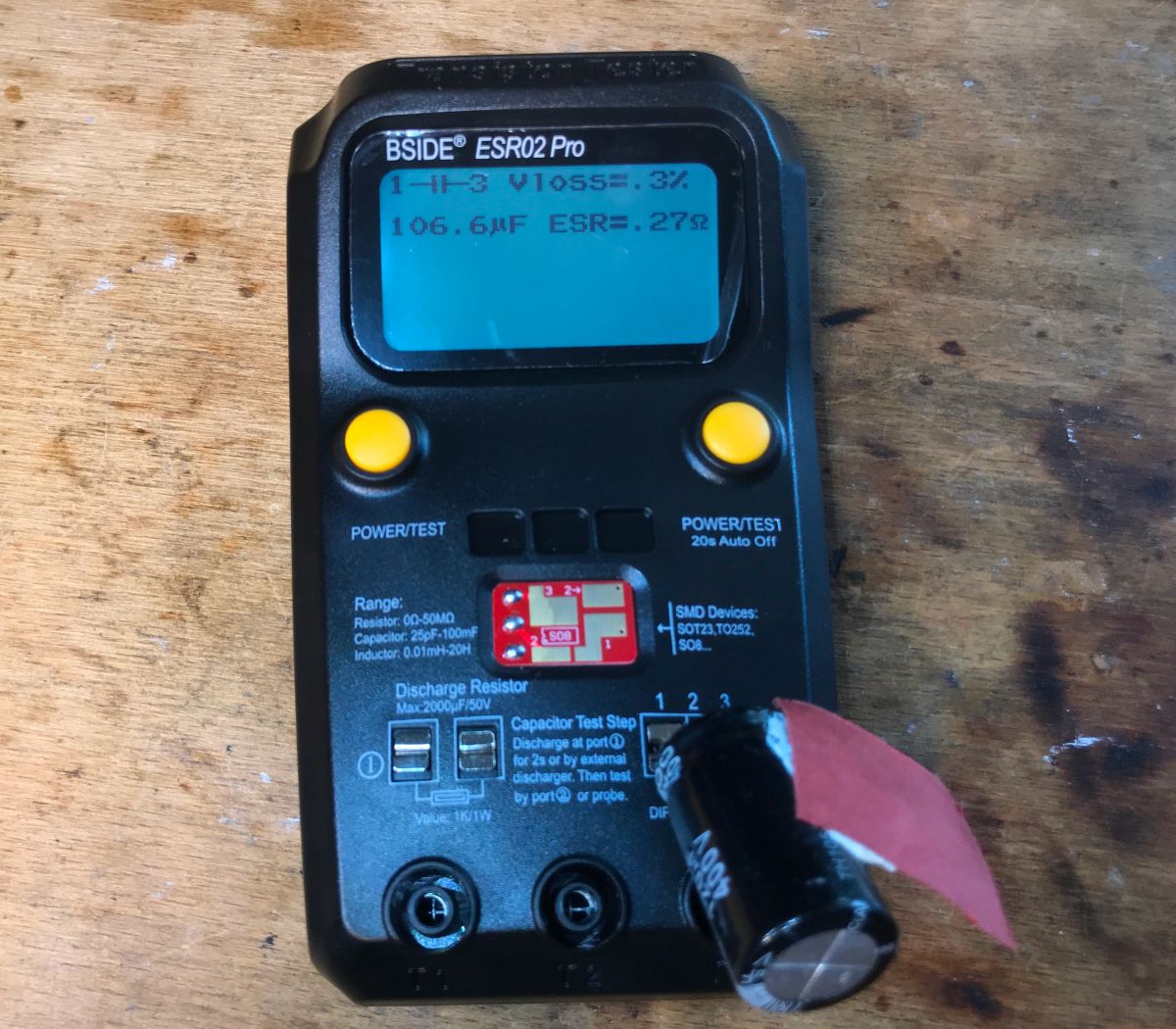
    BSIDE ESR02 Pro tester on a wooden table with a display showing capacitor measurements.


    Comparisons and tests
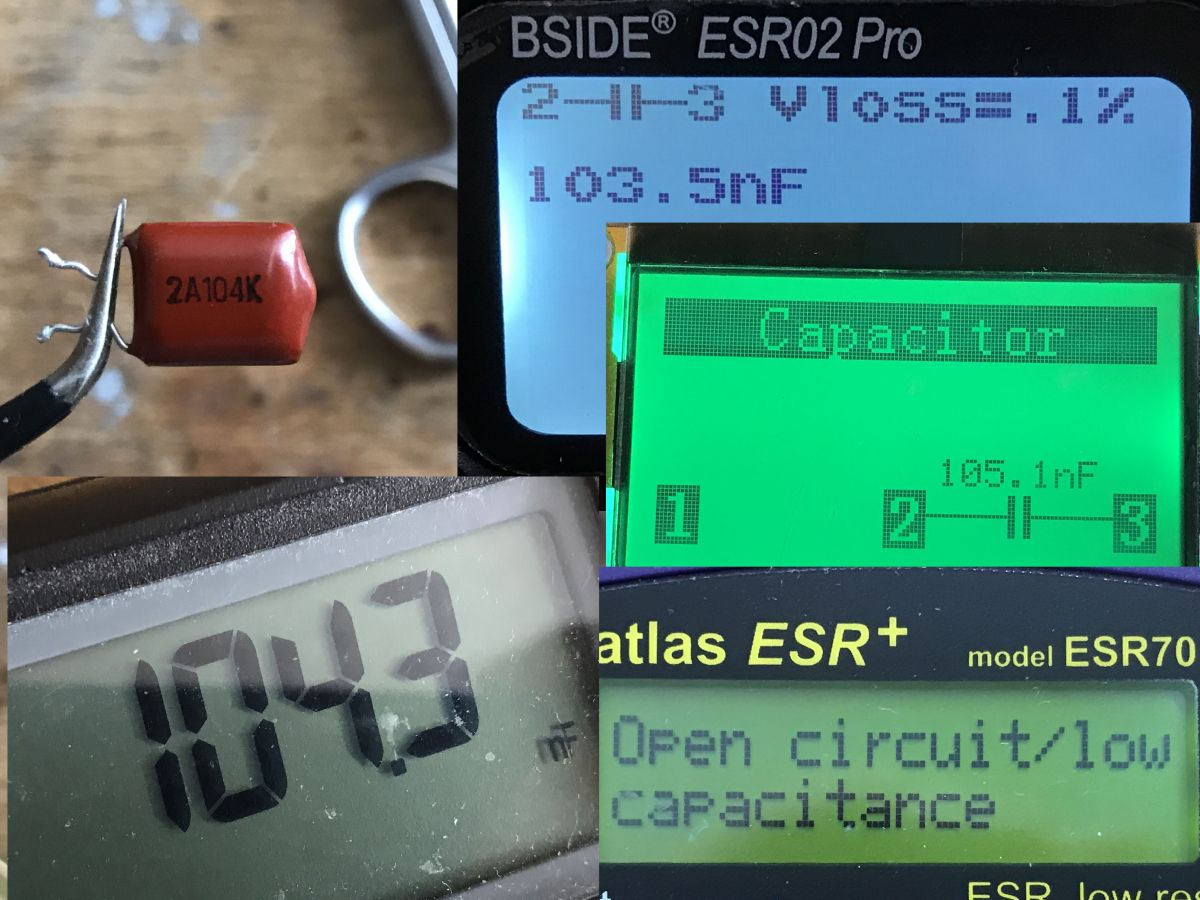
    Now I`m comparing the results from BSIDE ESR02 Pro with other testers, depending on what I measure there will be other competitors, because e.g. ESR70 only measures ESR... let`s start with capacitors:
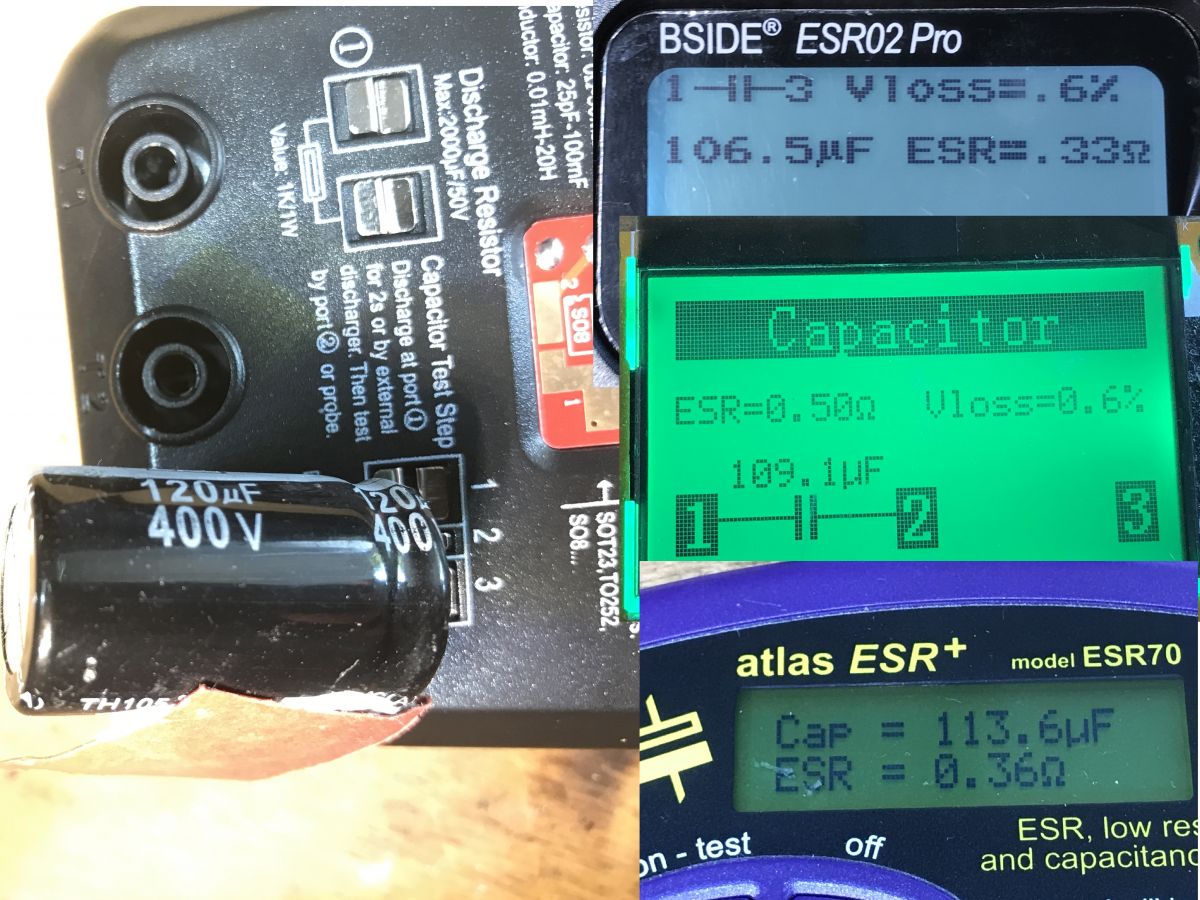
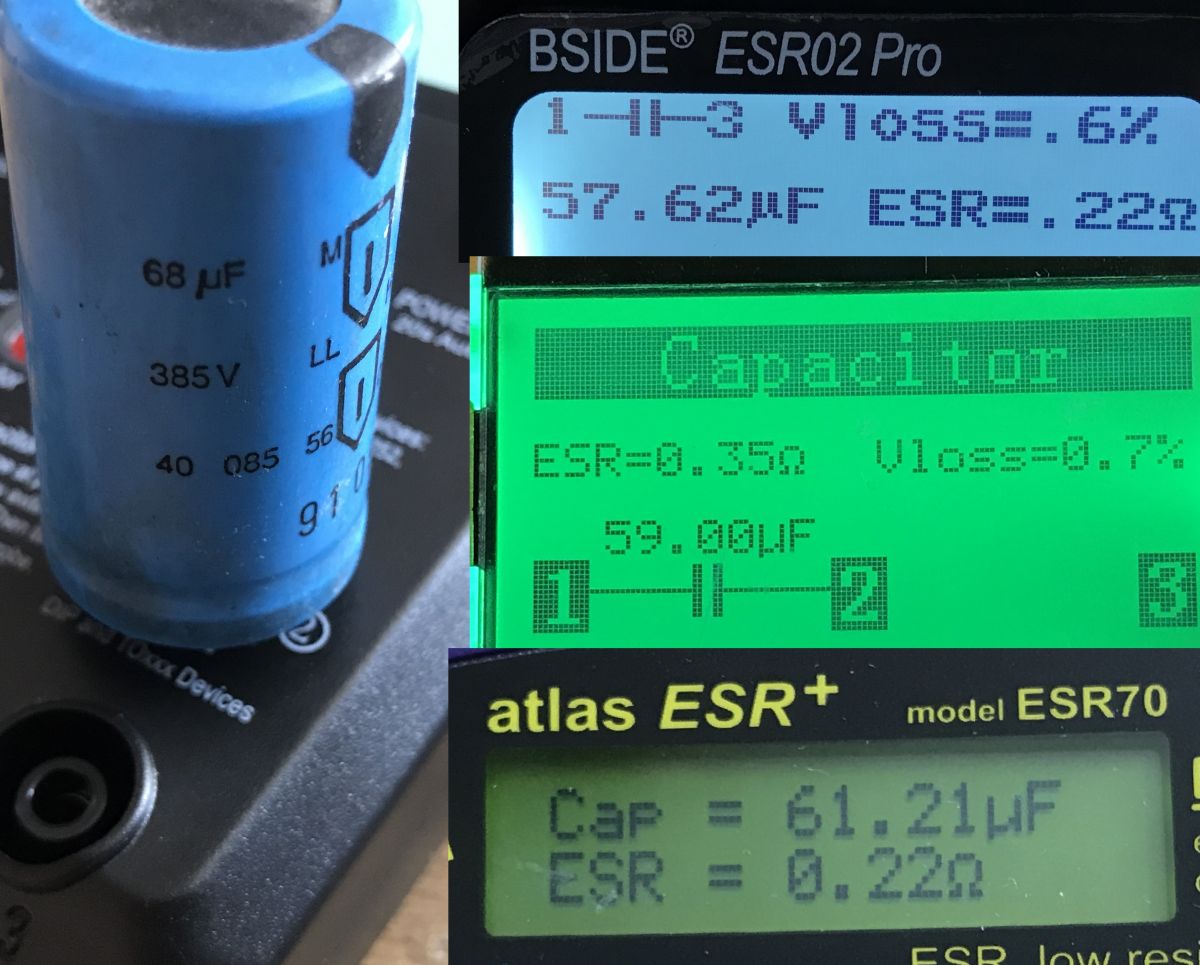
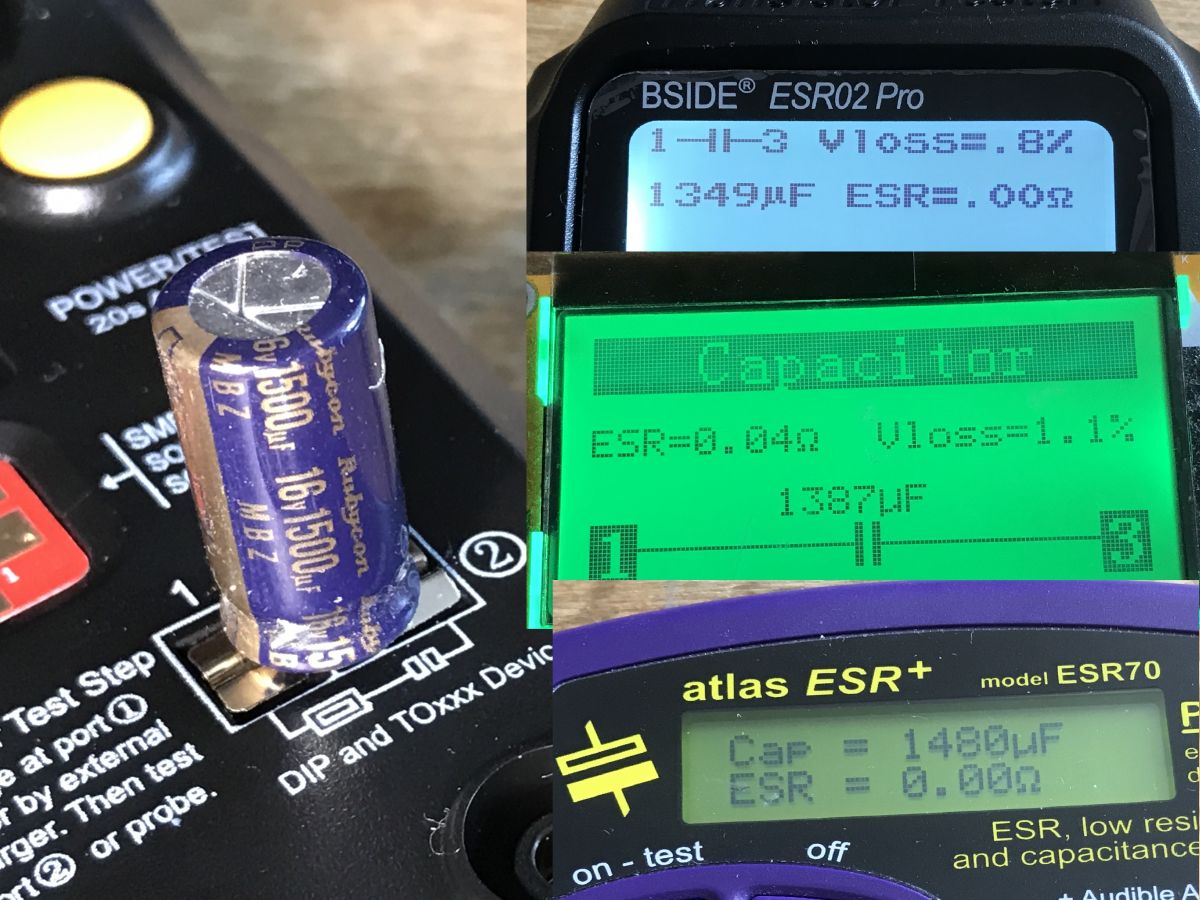
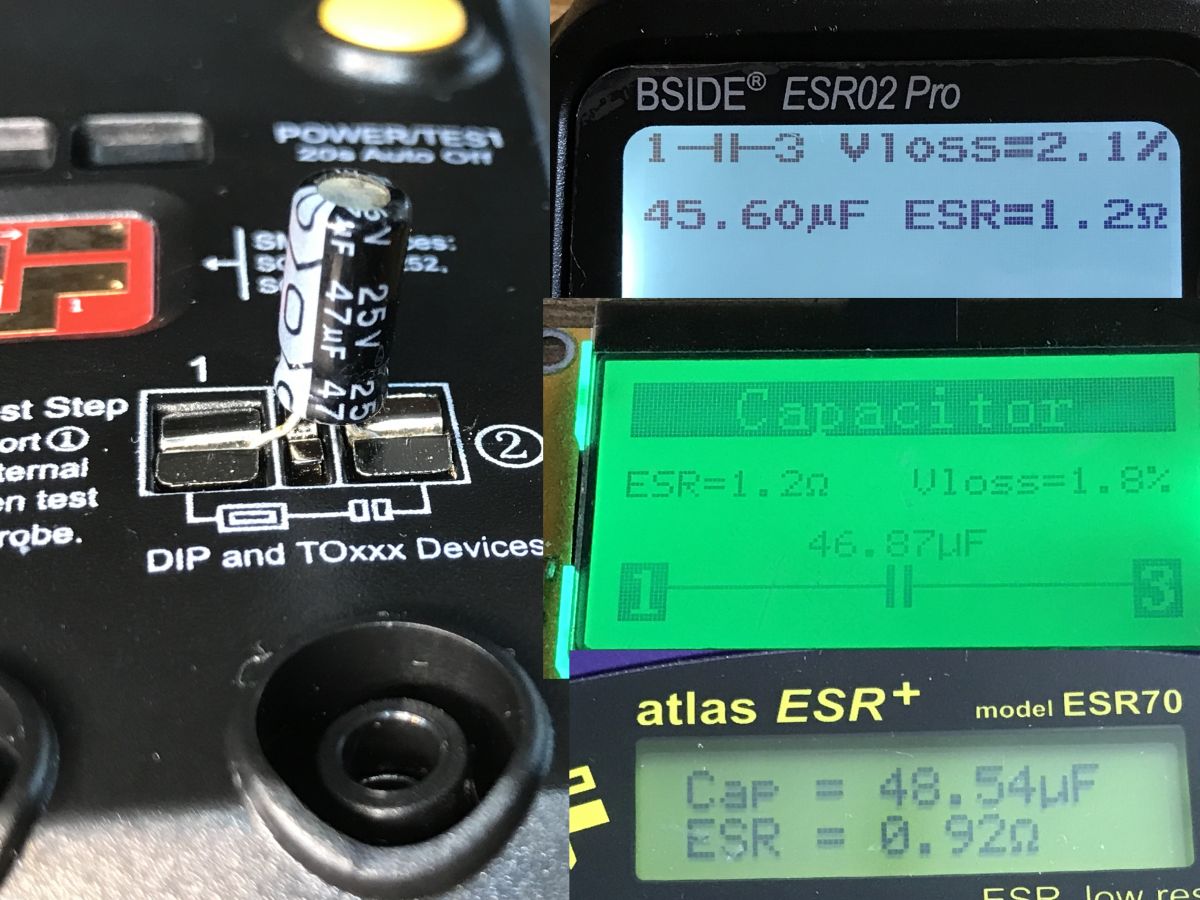
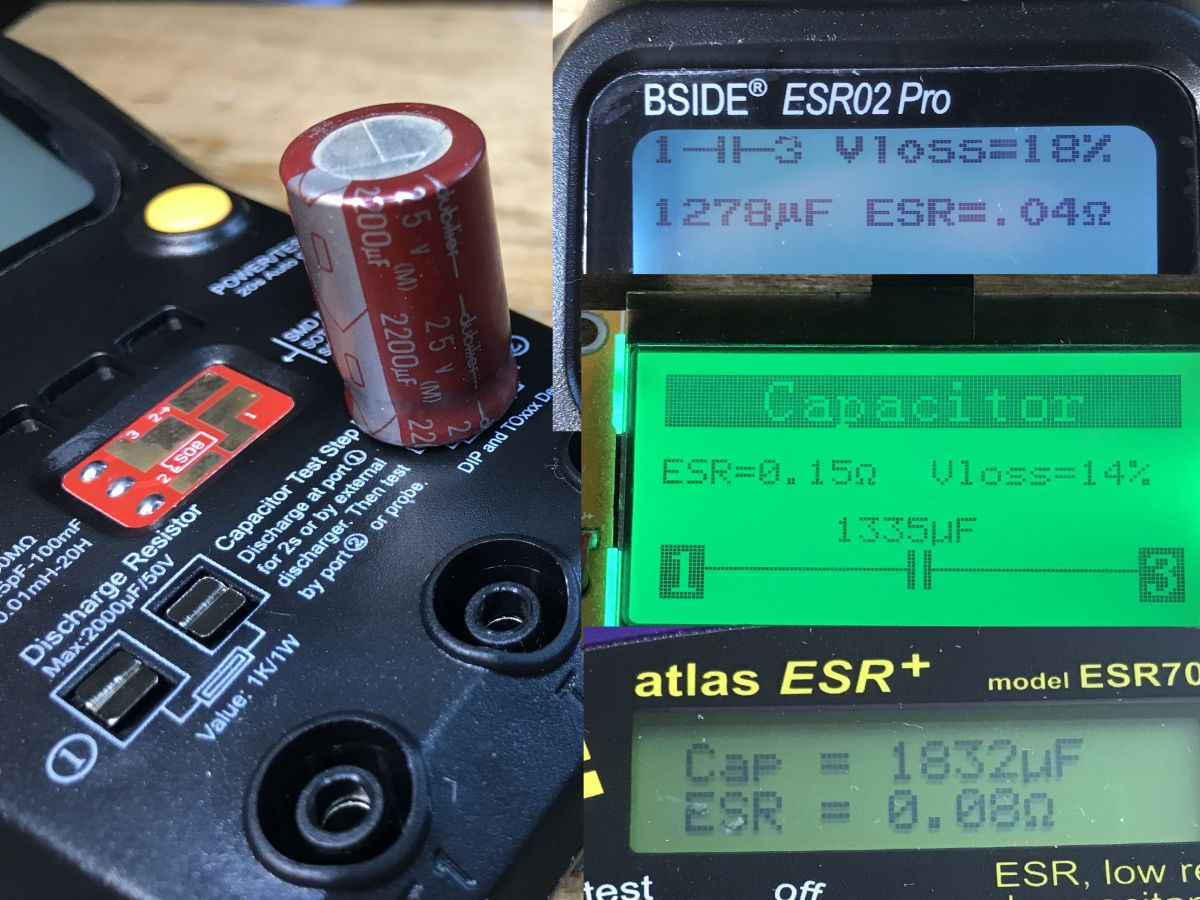
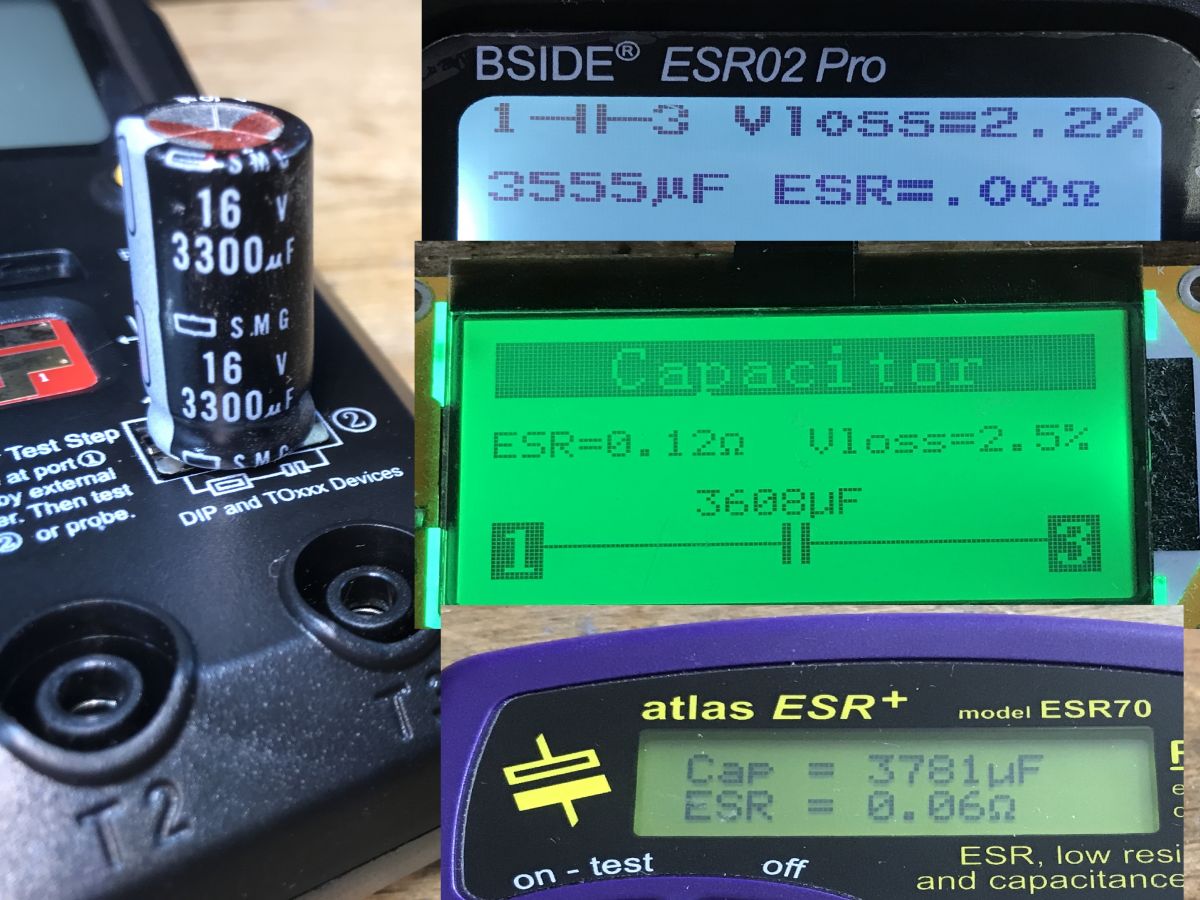
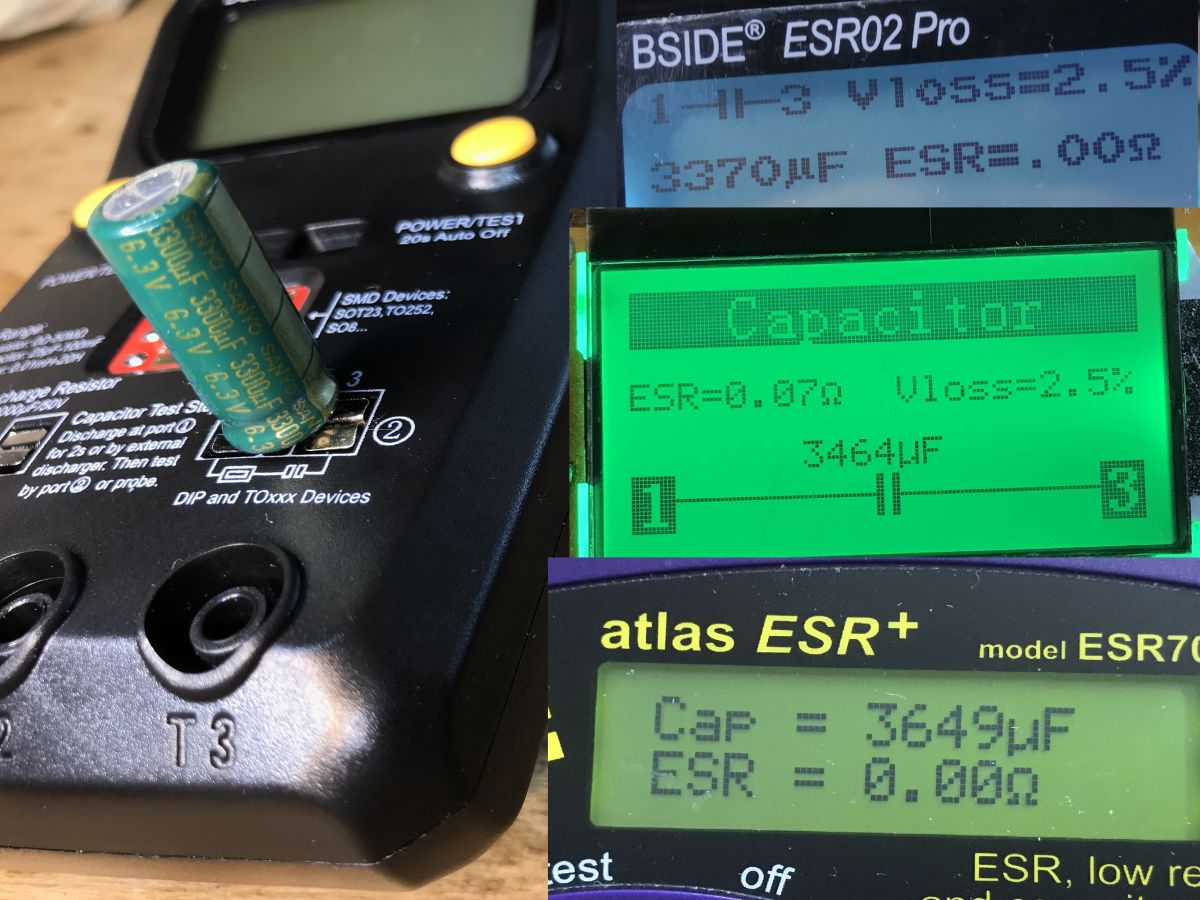
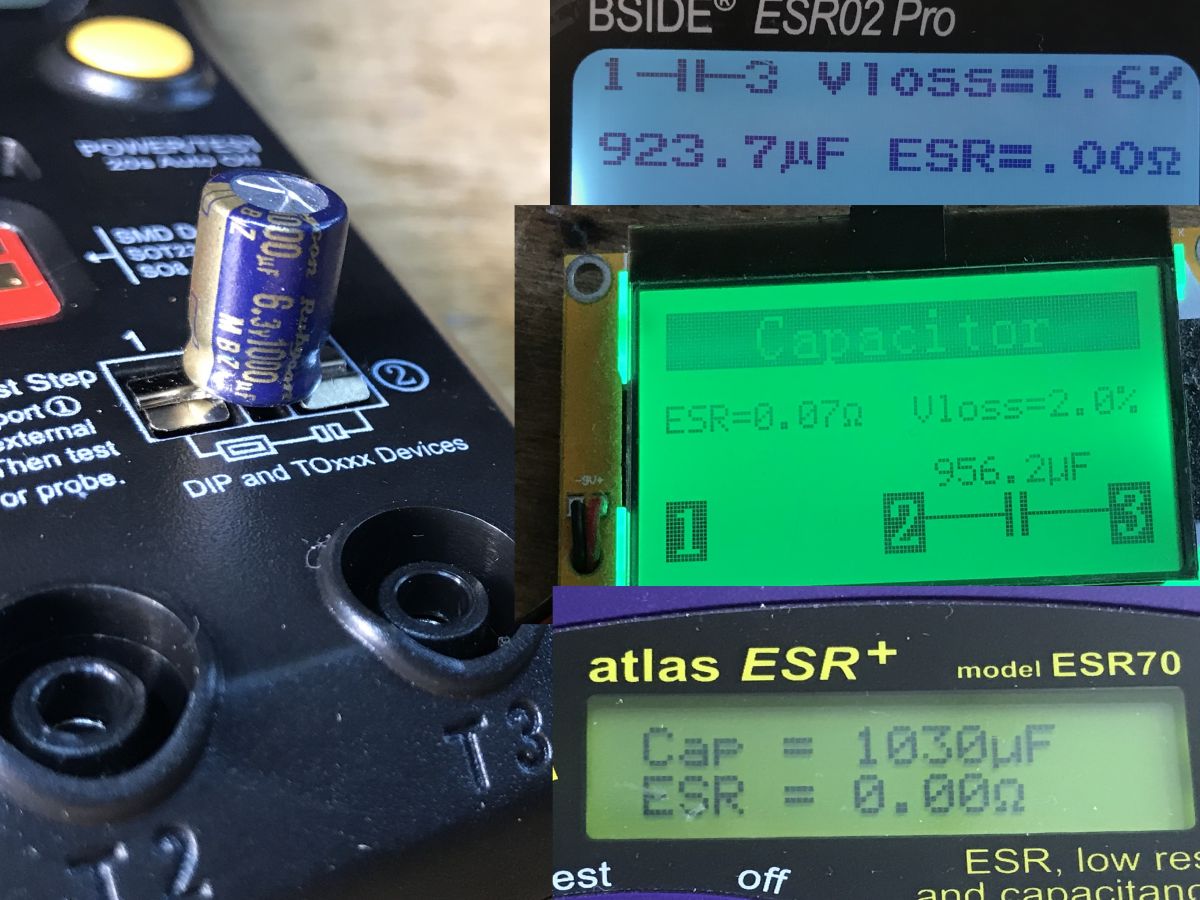
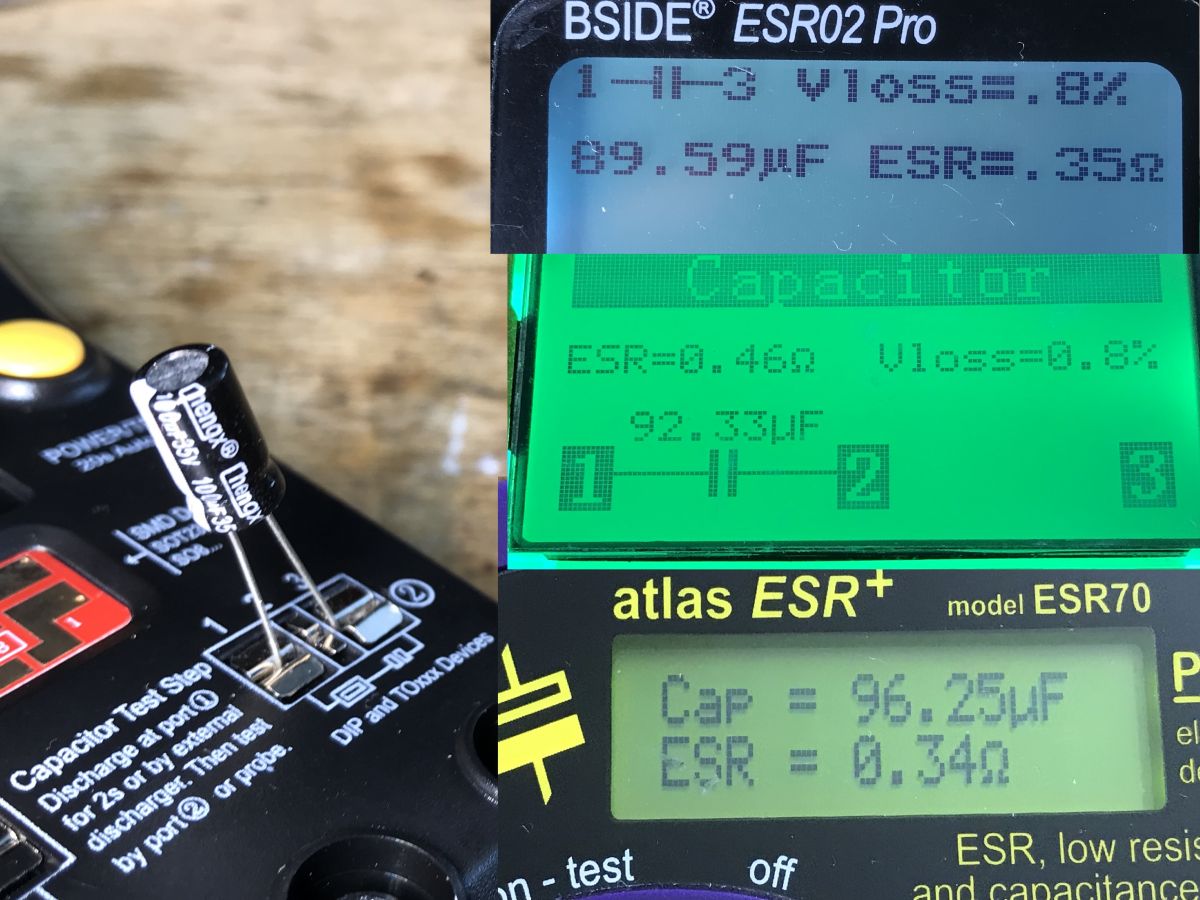
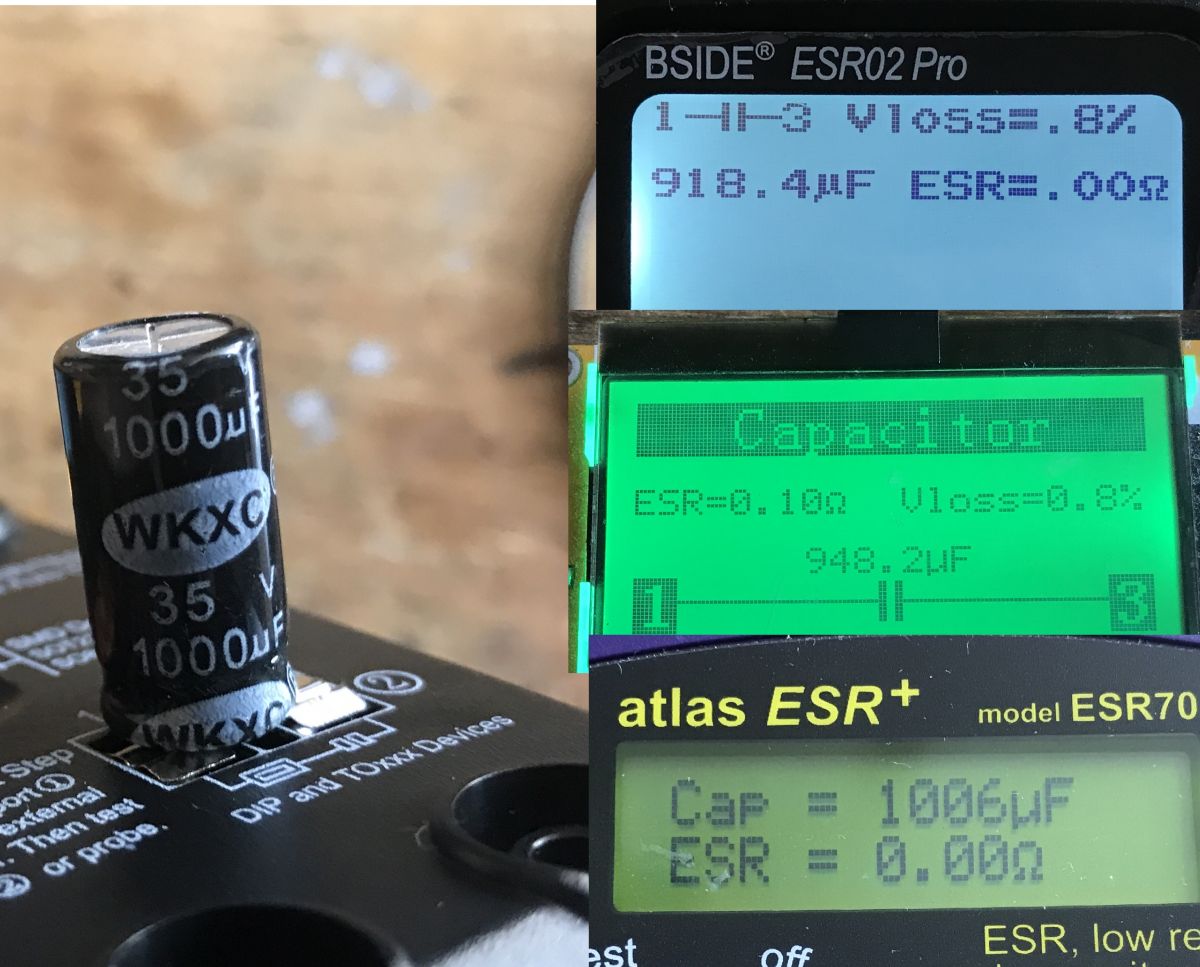
    Comparison of ESR measurements on a capacitor by different testers.
    BSIDE ESR02 Pro component tester displaying capacitor measurement results. Comparison of capacitor measurement results using different testers. BSIDE ESR02 Pro tester compared with other ESR testers. Component testers: BSIDE ESR02 Pro, LCR-T4, Atlas ESR+ BSIDE ESR02 Pro component tester compared with other devices. BSIDE ESR02 Pro tester displaying ESR measurements of a capacitor. Comparison of readings from BSIDE ESR02 Pro and Atlas ESR+ testers while testing a capacitor. Example of capacitor testing using BSIDE ESR02 Pro and Atlas ESR+ testers.
    Comparison of capacitor test results using BSIDE ESR02 Pro, LCR-T4, and ESR70 testers.
    LCR-T4 seems to slightly overestimate ESR, or maybe the other two underestimate it?

    Maybe now the BD140 transistor:
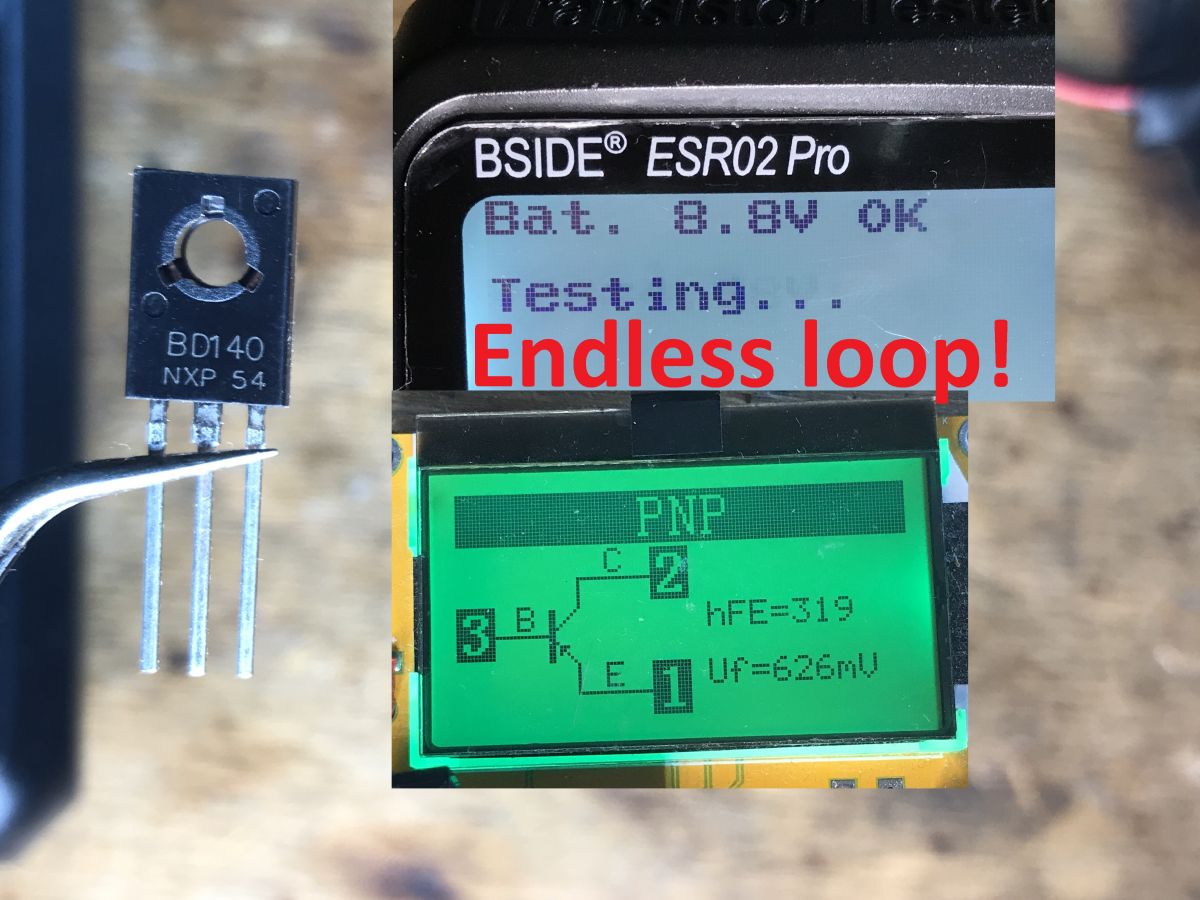
    BSIDE ESR02 Pro tester in a loop during BD140 transistor test.
    ESR02 gets into testing loops and produces no results.

    1N5819 Schottky diodes:
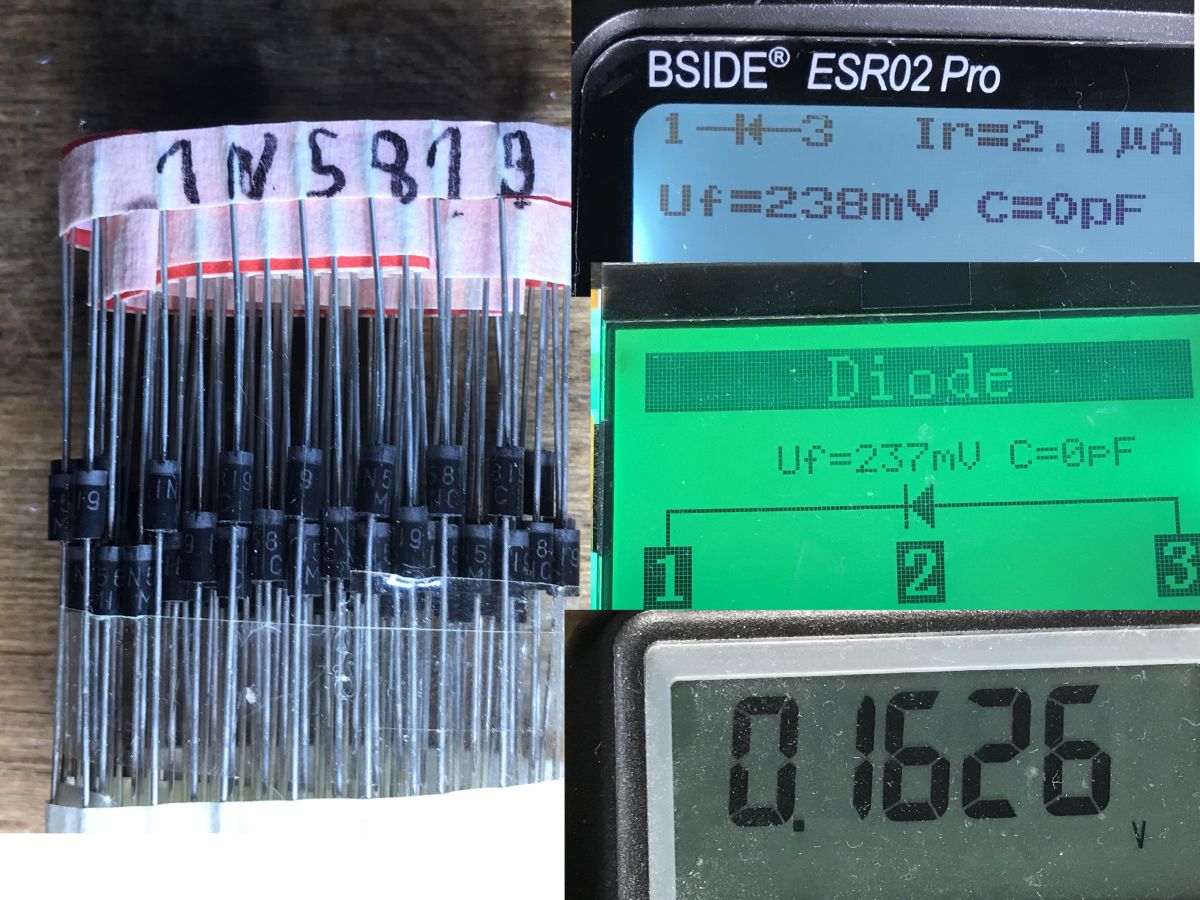
    Comparison of Schottky diode measurement results using the BSIDE ESR02 Pro tester
    Brymen shows slightly lower voltage.

    BC557:
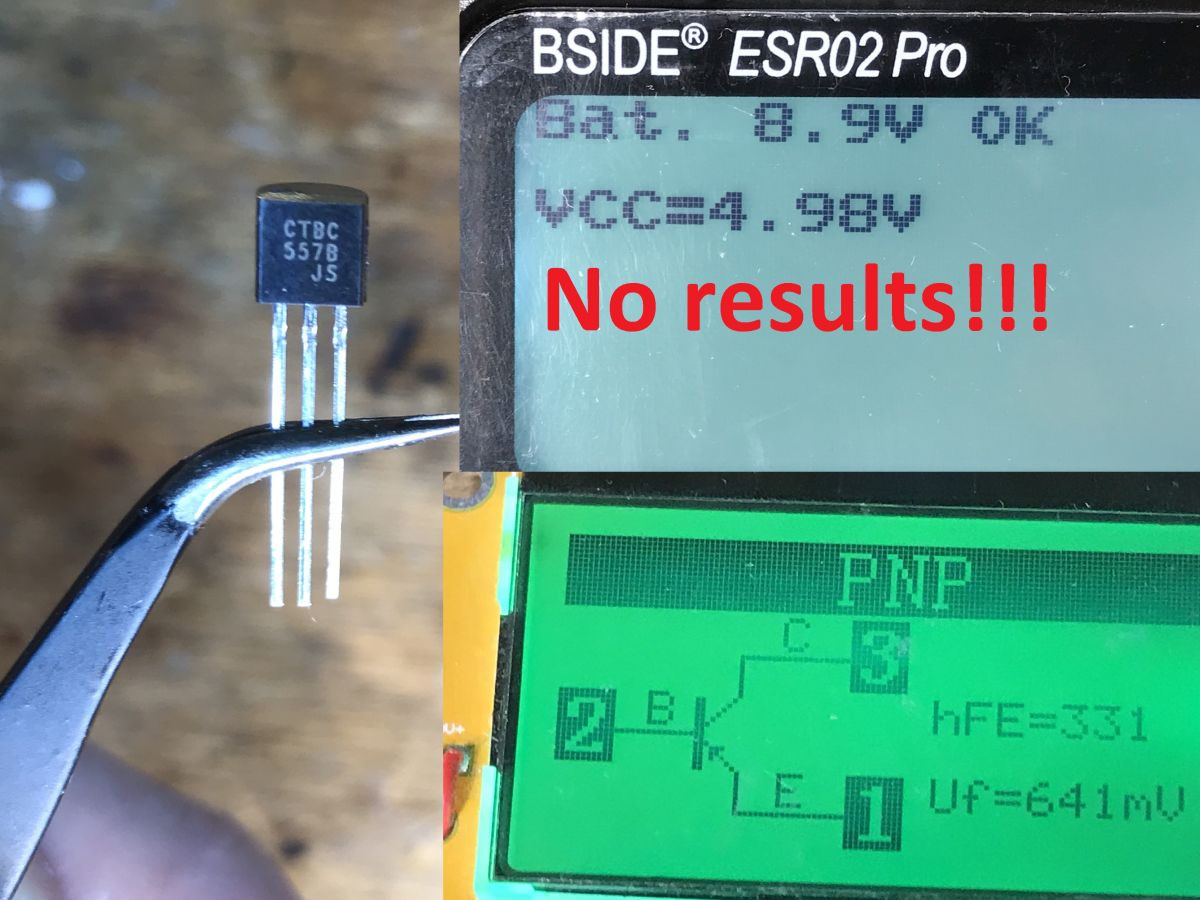
    The image shows a CTBC 557B transistor held by tweezers and the screen of the BSIDE ESR02 Pro tester displaying No results!!!.
    ESR02 failed again.

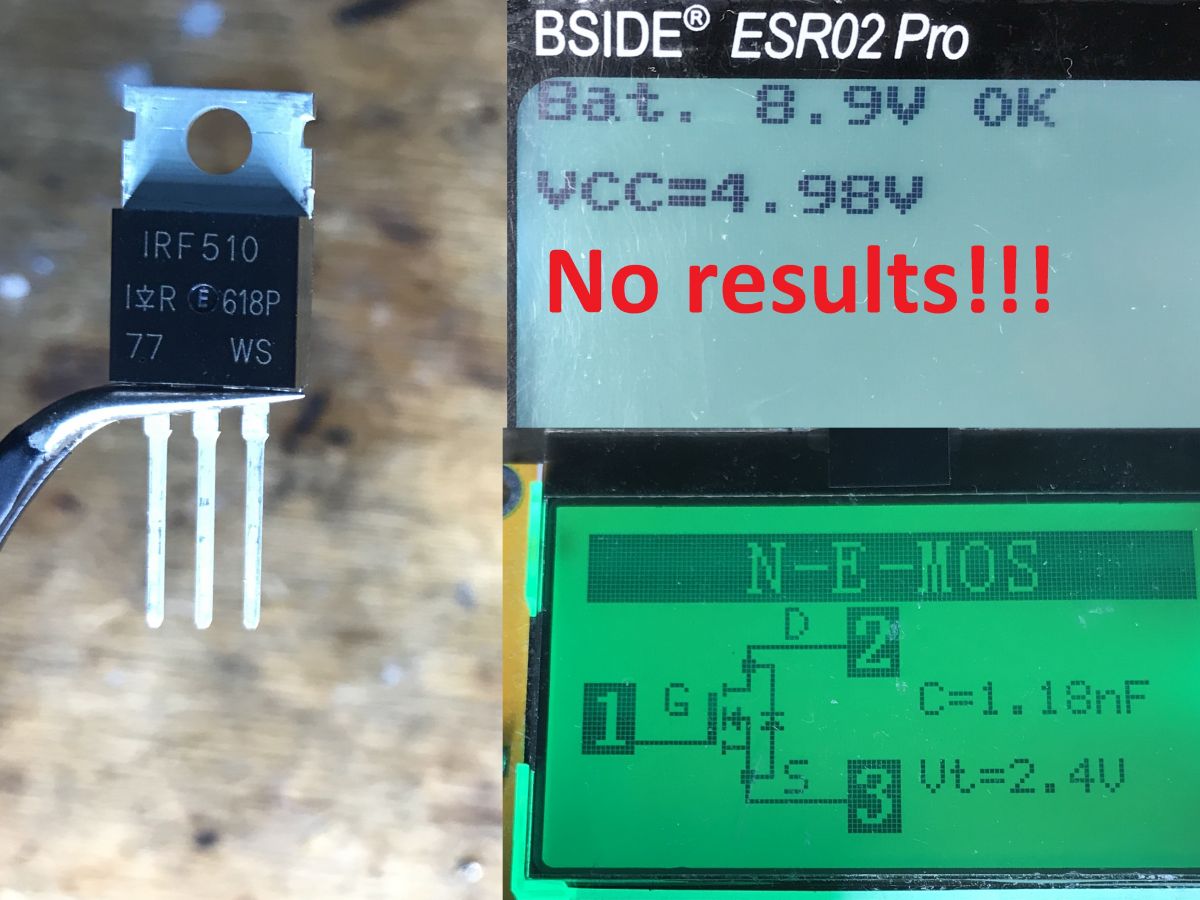
    IRF510:
    BSIDE ESR02 Pro component tester showing no results for IRF510 transistor.
    ESR02 failed again:

    Measurement of the diode voltage drop - quite good, both testers give similar results, Brymen underestimates:
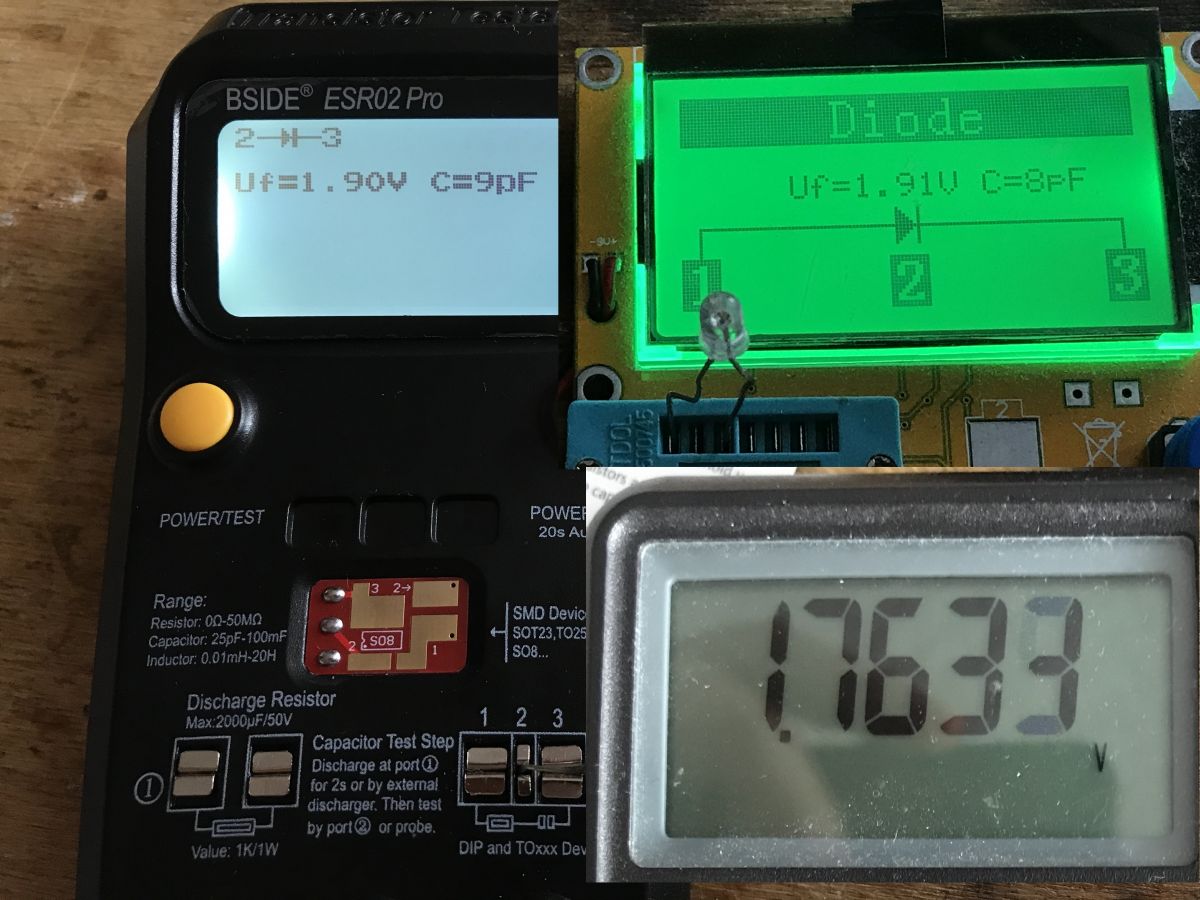
    BSIDE ESR02 Pro component tester, LCR-T4, and a digital multimeter on a table.

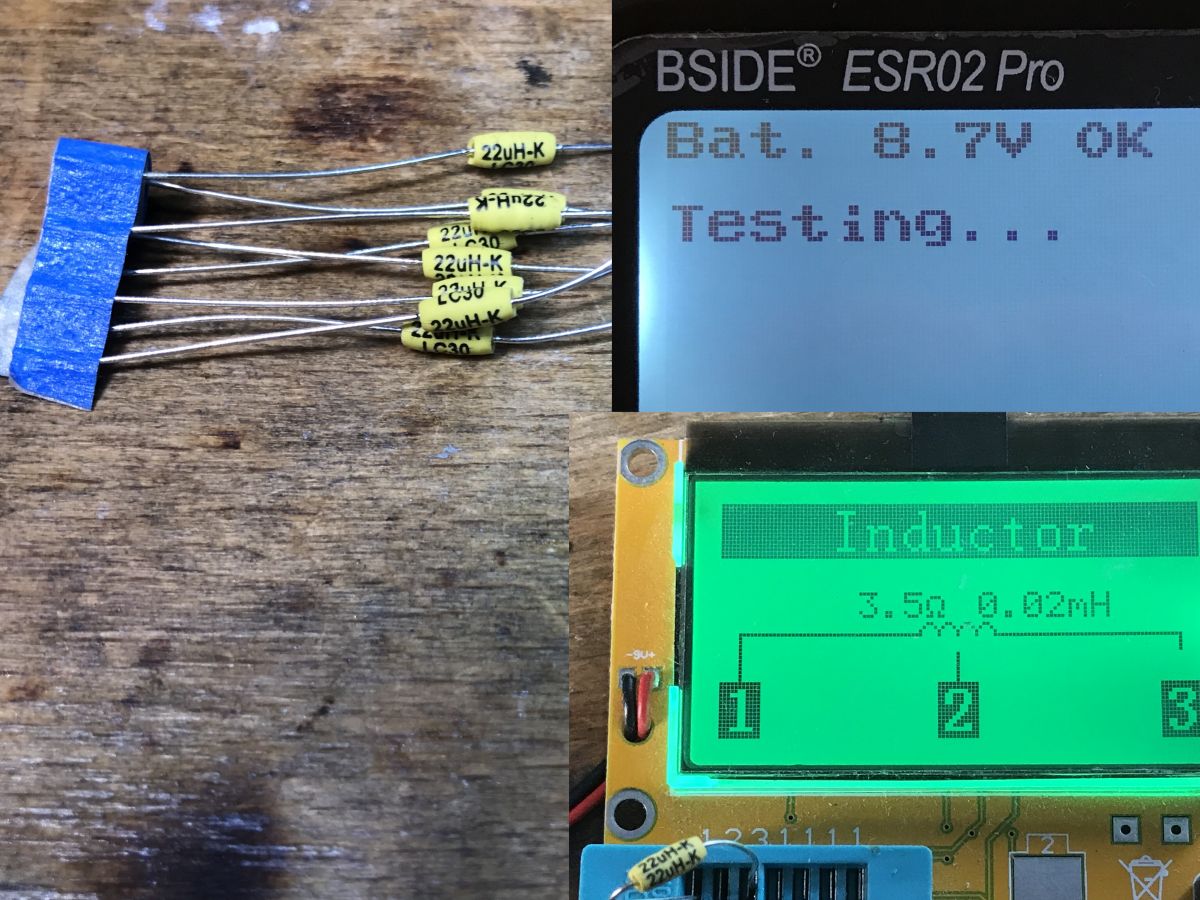
    22uH choke:
    BSIDE ESR02 Pro tester evaluating inductors.
    ESR02 failed.

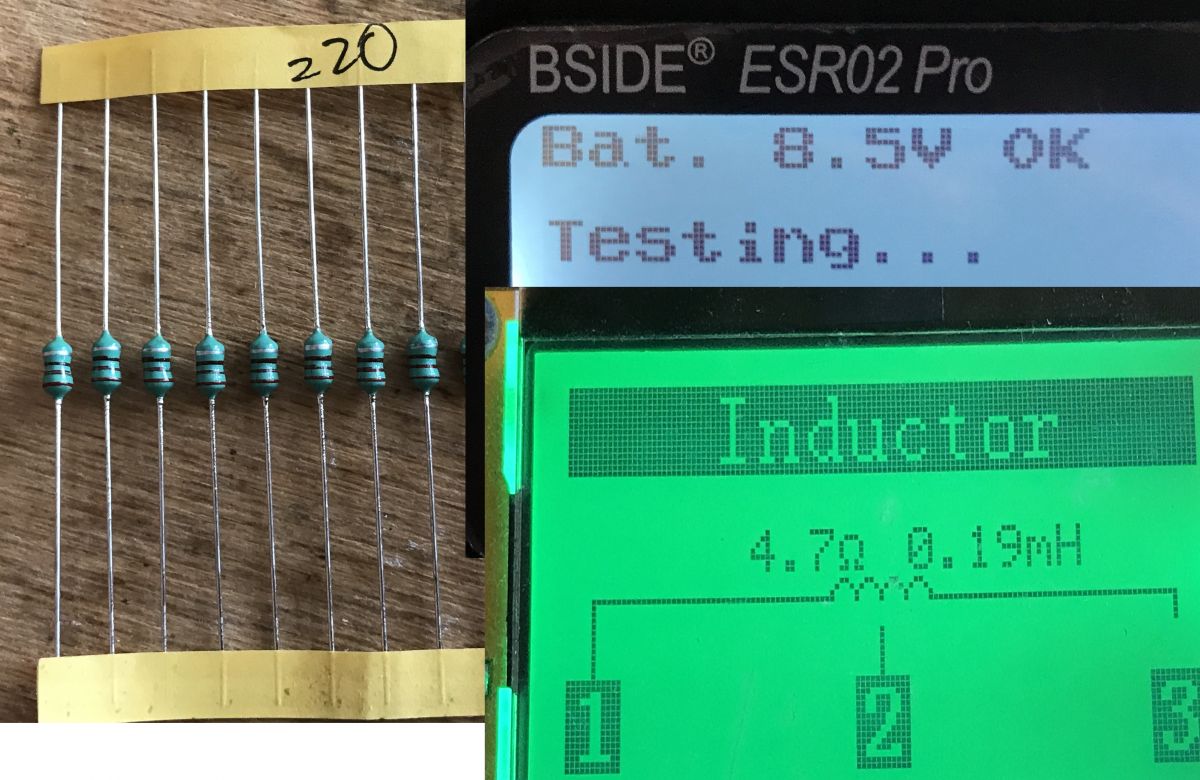
    220uH choke:
    Image of the BSIDE ESR02 Pro component tester performing an inductor measurement alongside resistors labeled as 220 Ohm.
    ESR02 failed.

    100nF capacitor:
    Comparison of capacitor measurement results using three testers.
    ESR70 couldn`t handle it, but that`s not what it`s for.

    0.22 ohm resistor:
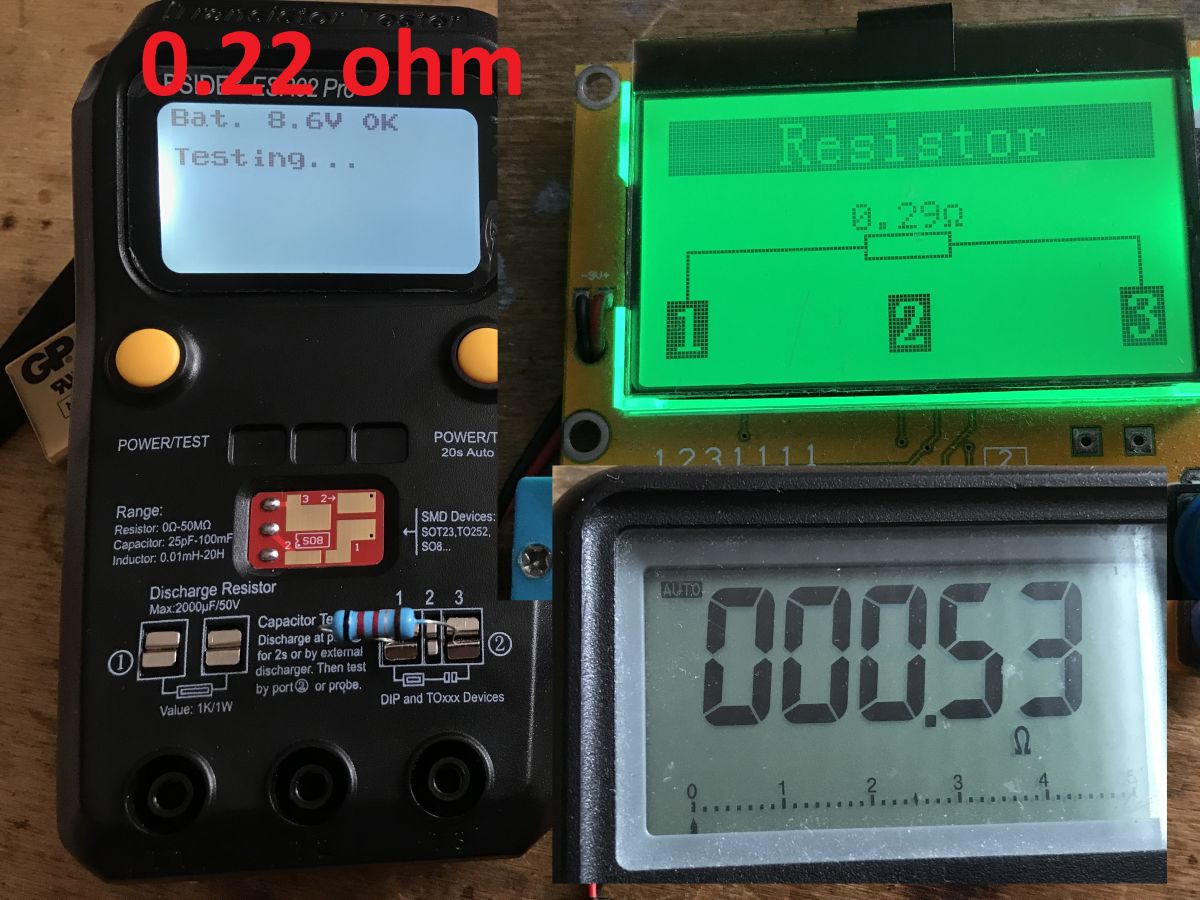
    Comparison of resistor measurement results using three testers.
    Only the LCR-T4 showed reasonable results.

    100pF capacitor:
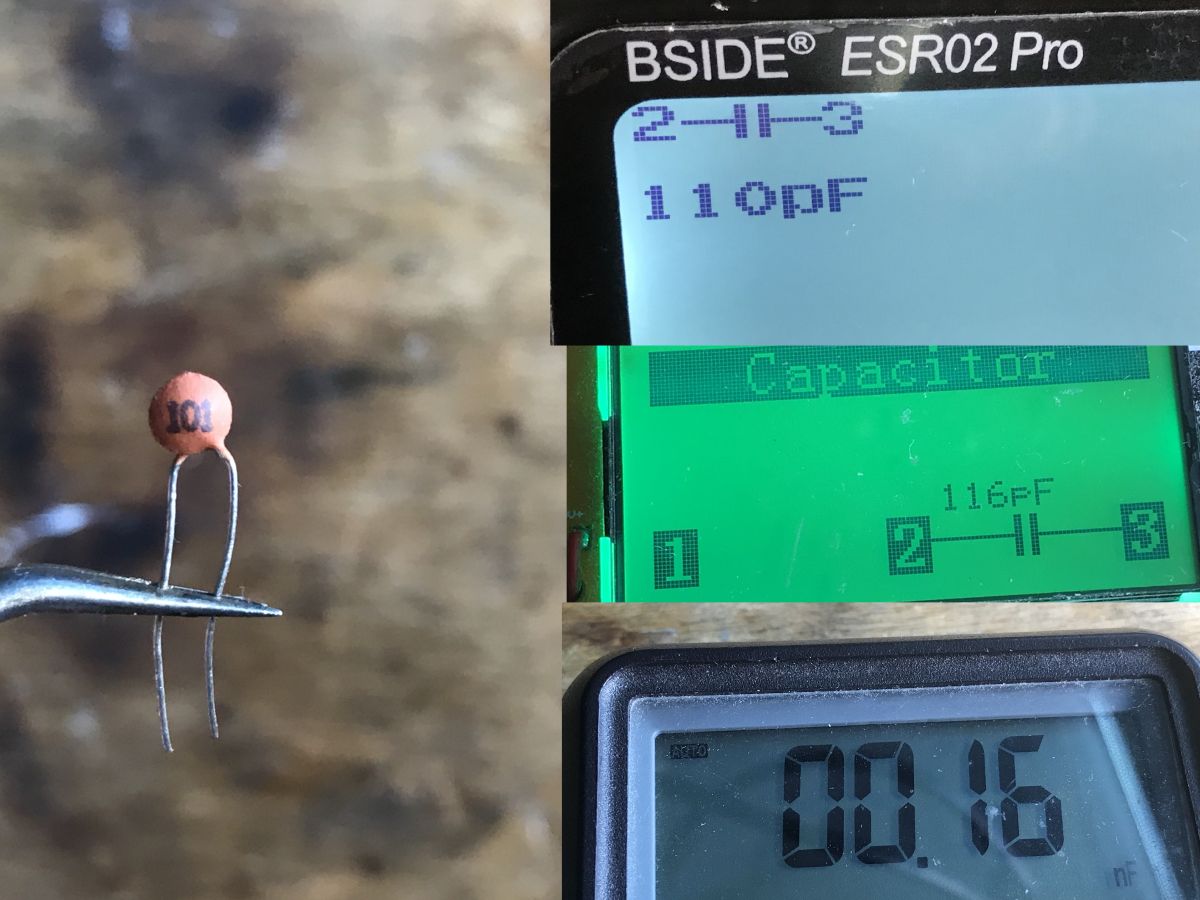
    BSIDE ESR02 Pro tester comparing capacitor values
    Brymen lost a bit.

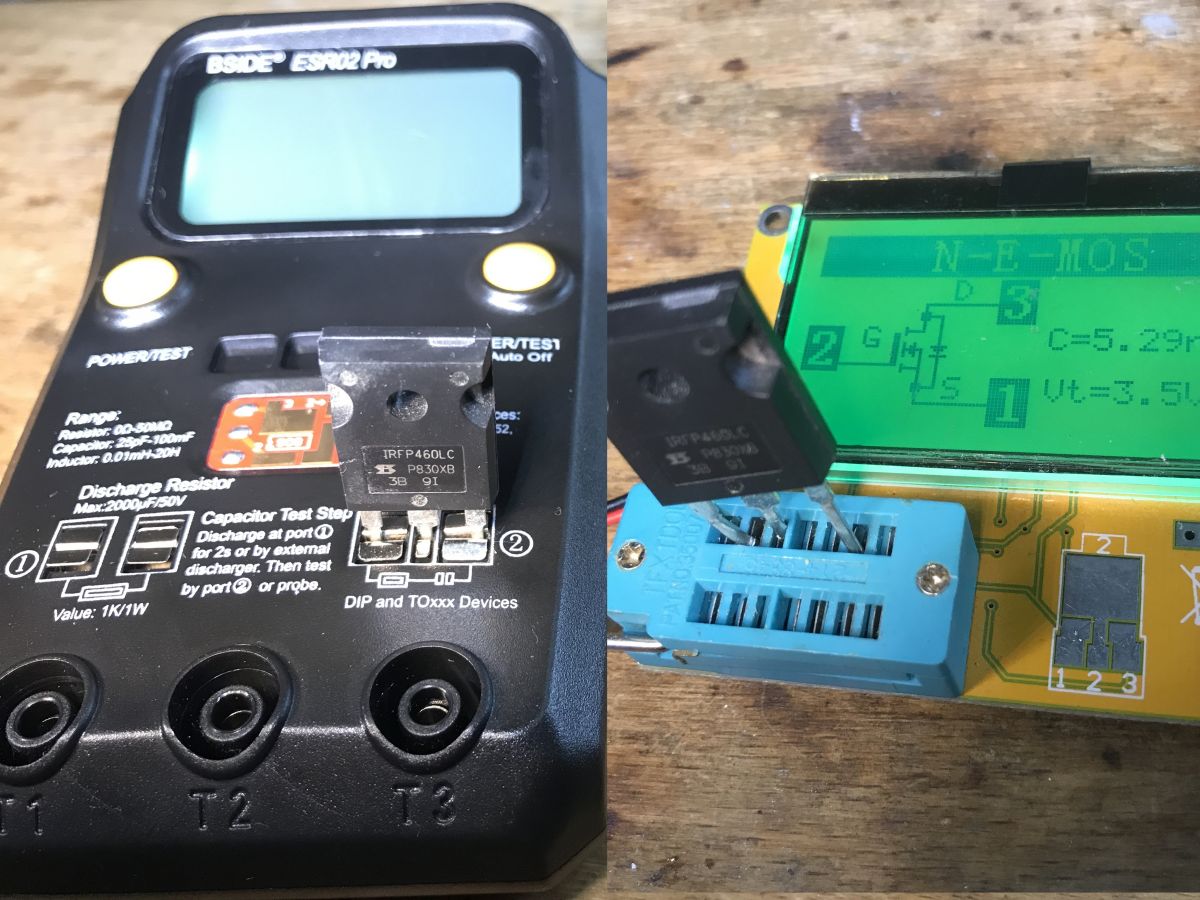
    IRFP460:
    Comparison of BSIDE ESR02 Pro and LCR-T4 component testers.
    ESR02 failed.

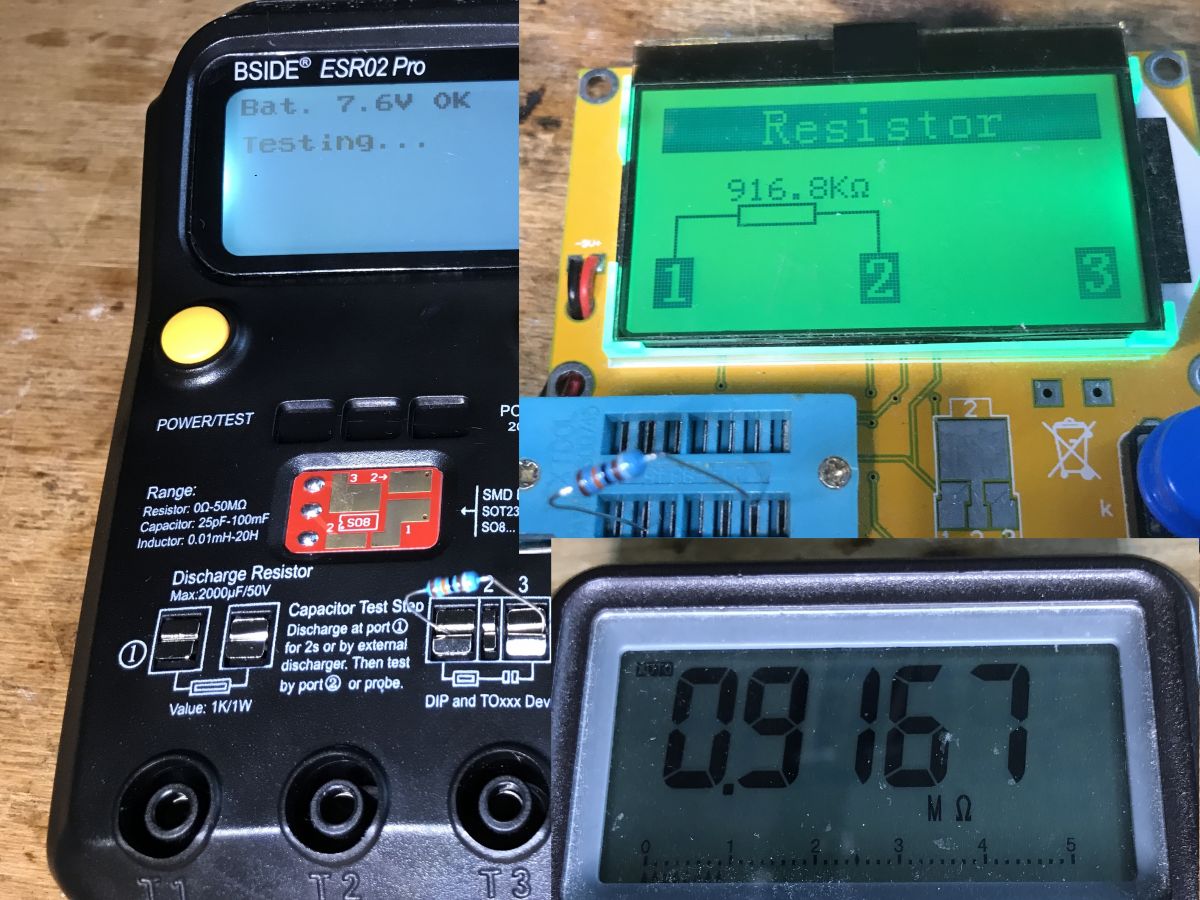
    1M Resistor:
    Electronic component testers BSIDE ESR02 Pro, LCR-T4, and multimeter.
    ESR02 failed...

    Measurement time
    ESR02 vs LCR-T4 vs ESR70:


    Rather everything within expectations.

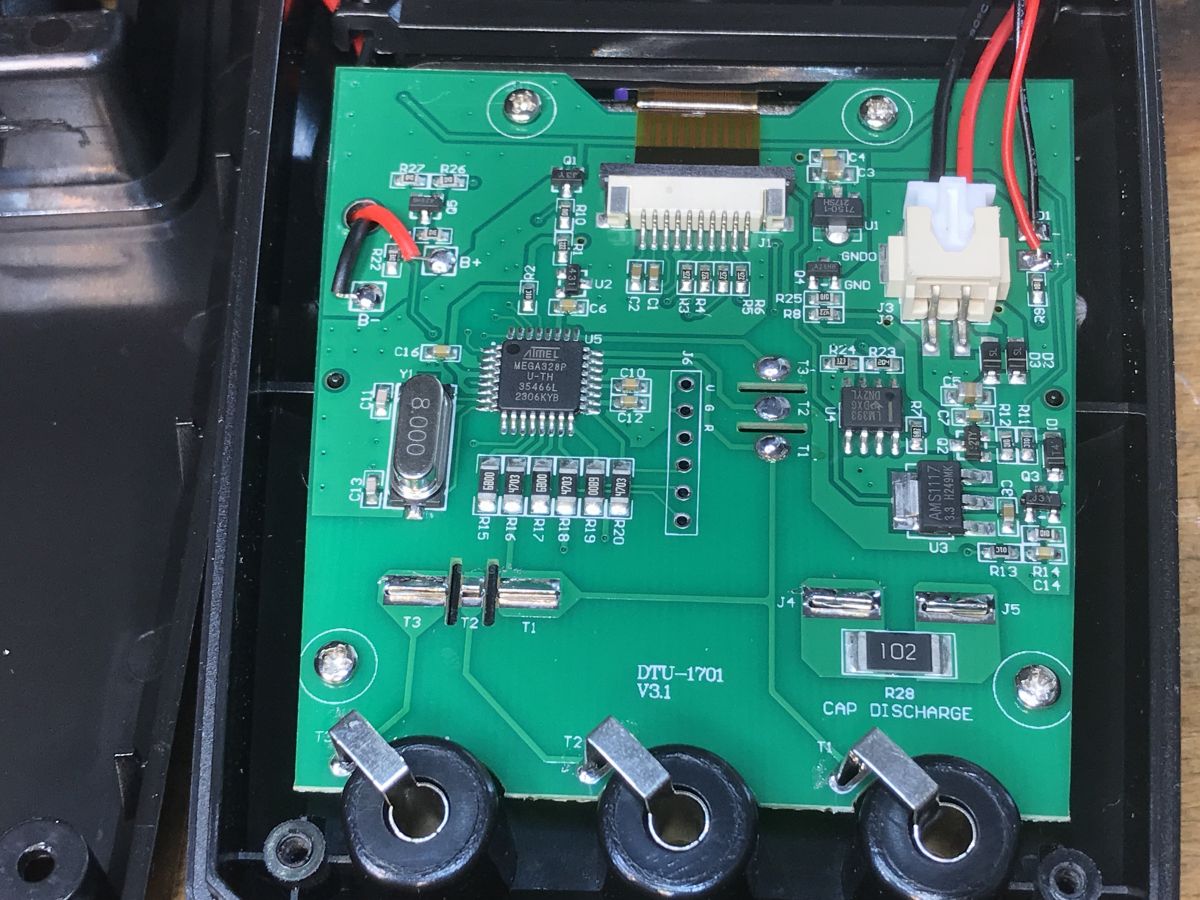
    ESR02 interior
    Unscrew the screws and look inside:
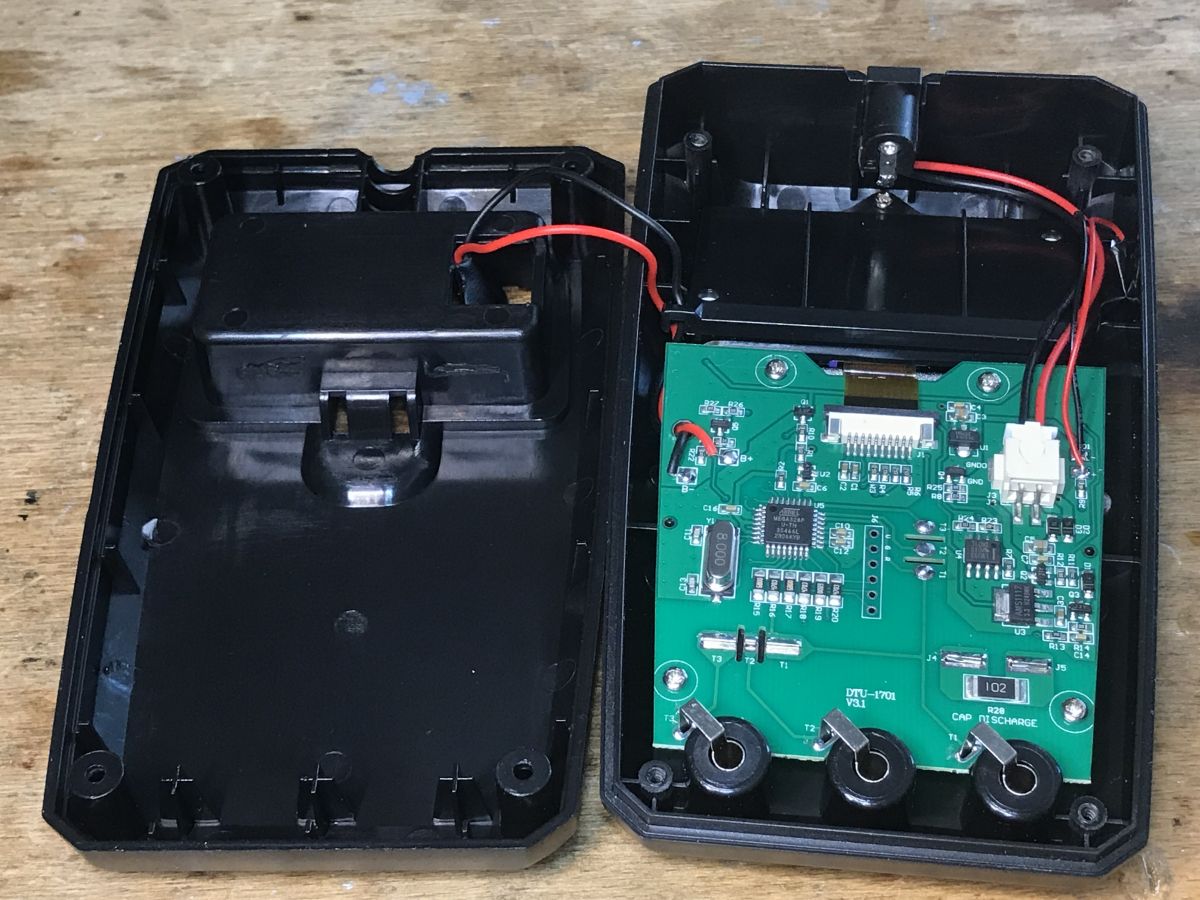
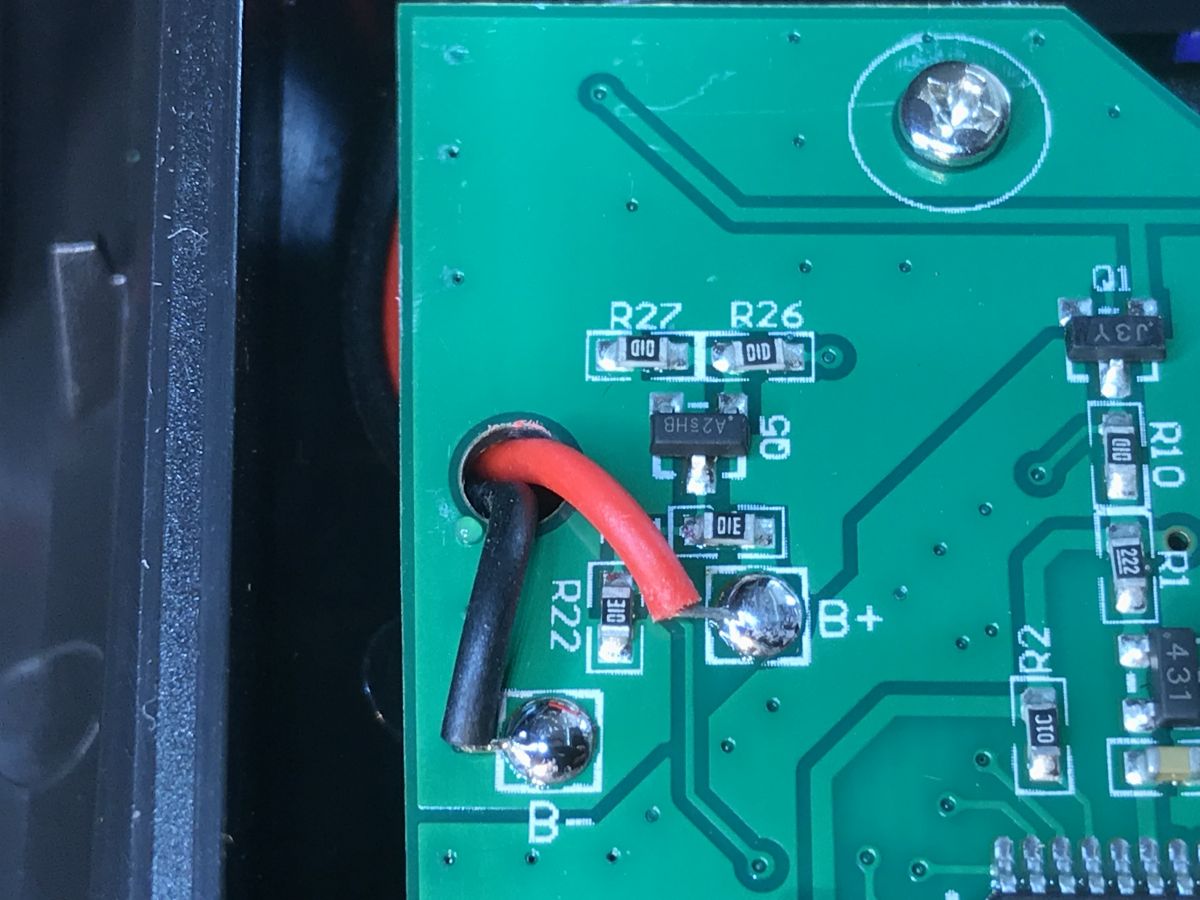
    BSIDE ESR02 Pro component tester open with internal circuit visible.
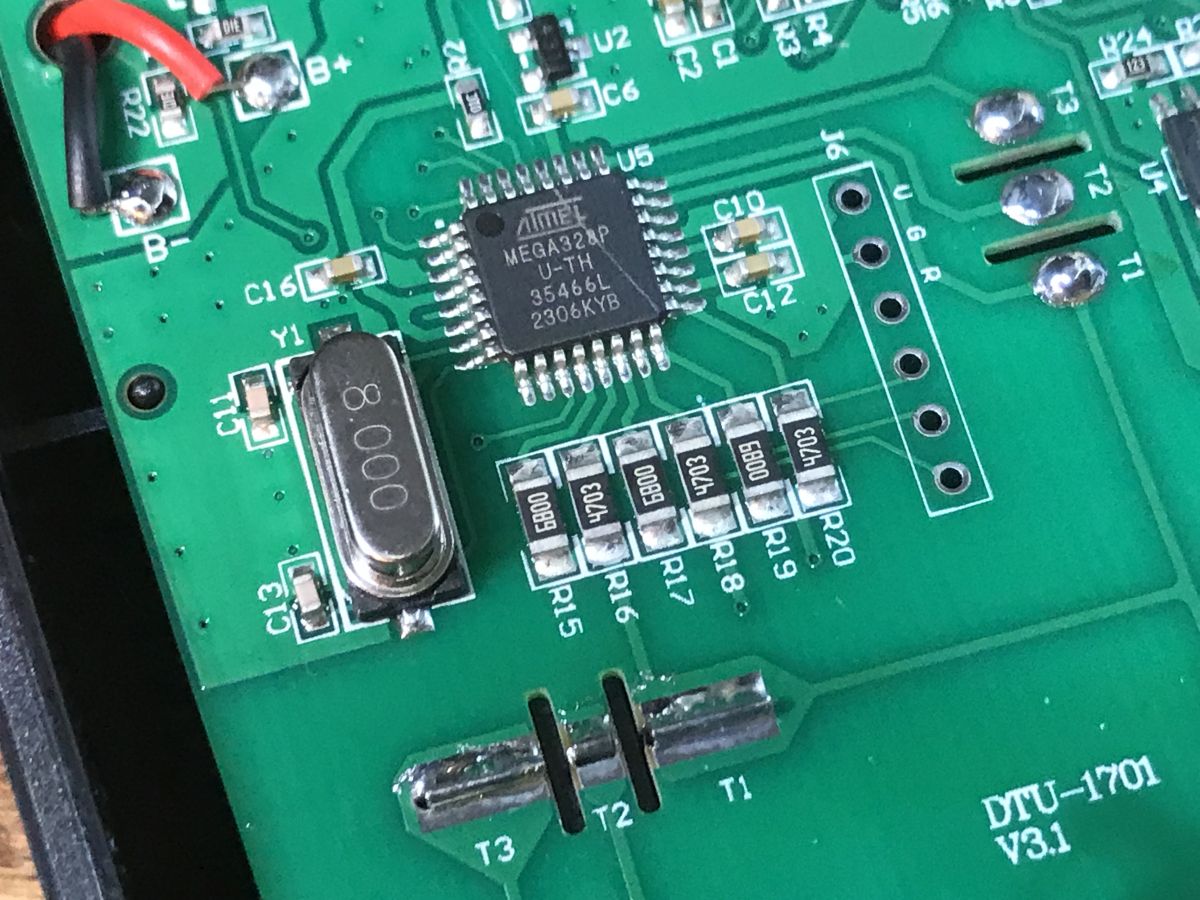
    Yes, this is another Atmega-based tester, here on Atmega328P.
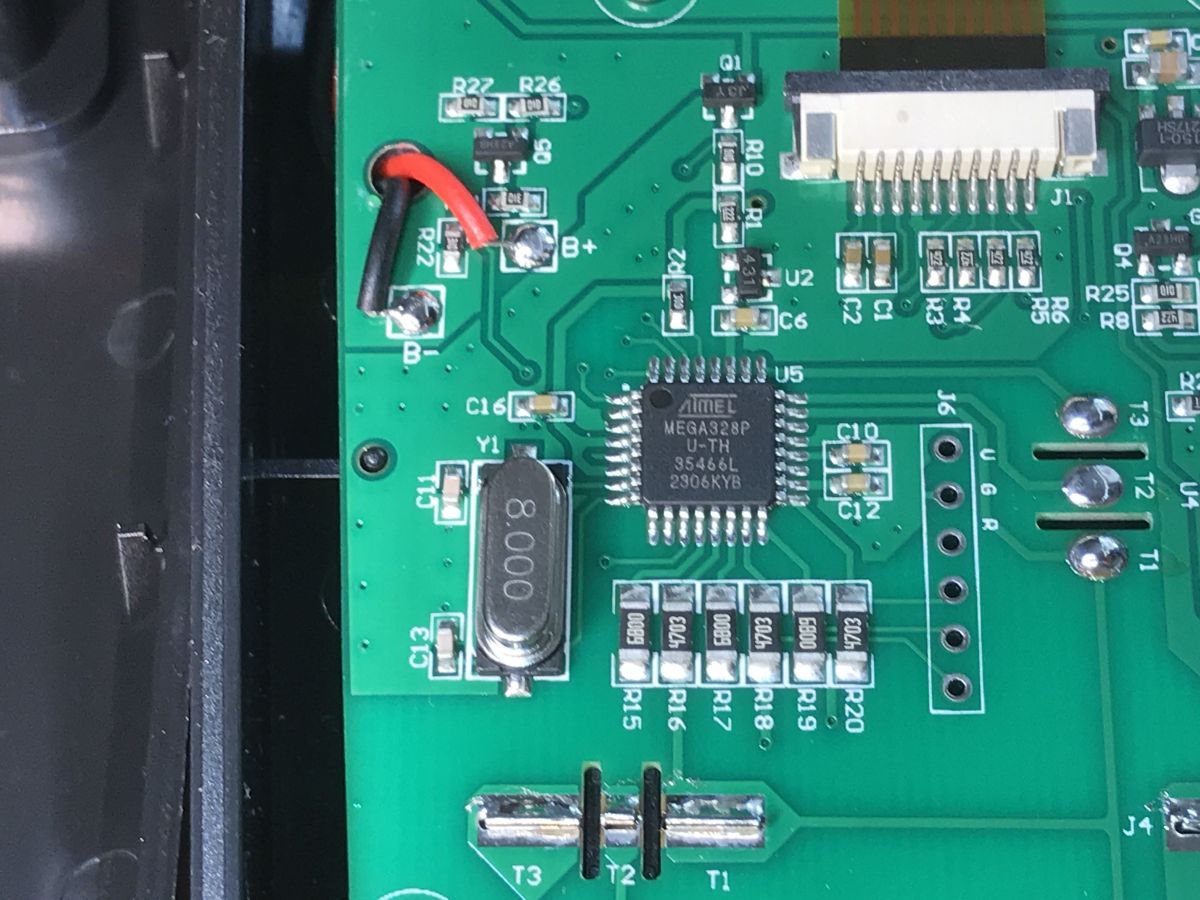
    BSIDE ESR02 Pro component tester with visible Atmega328P chip. Inside of the BSIDE ESR02 Pro component tester with visible electronic circuits.
    In addition, we have a 3.3V AMS1117 LDO and an LM393 compatator inside.
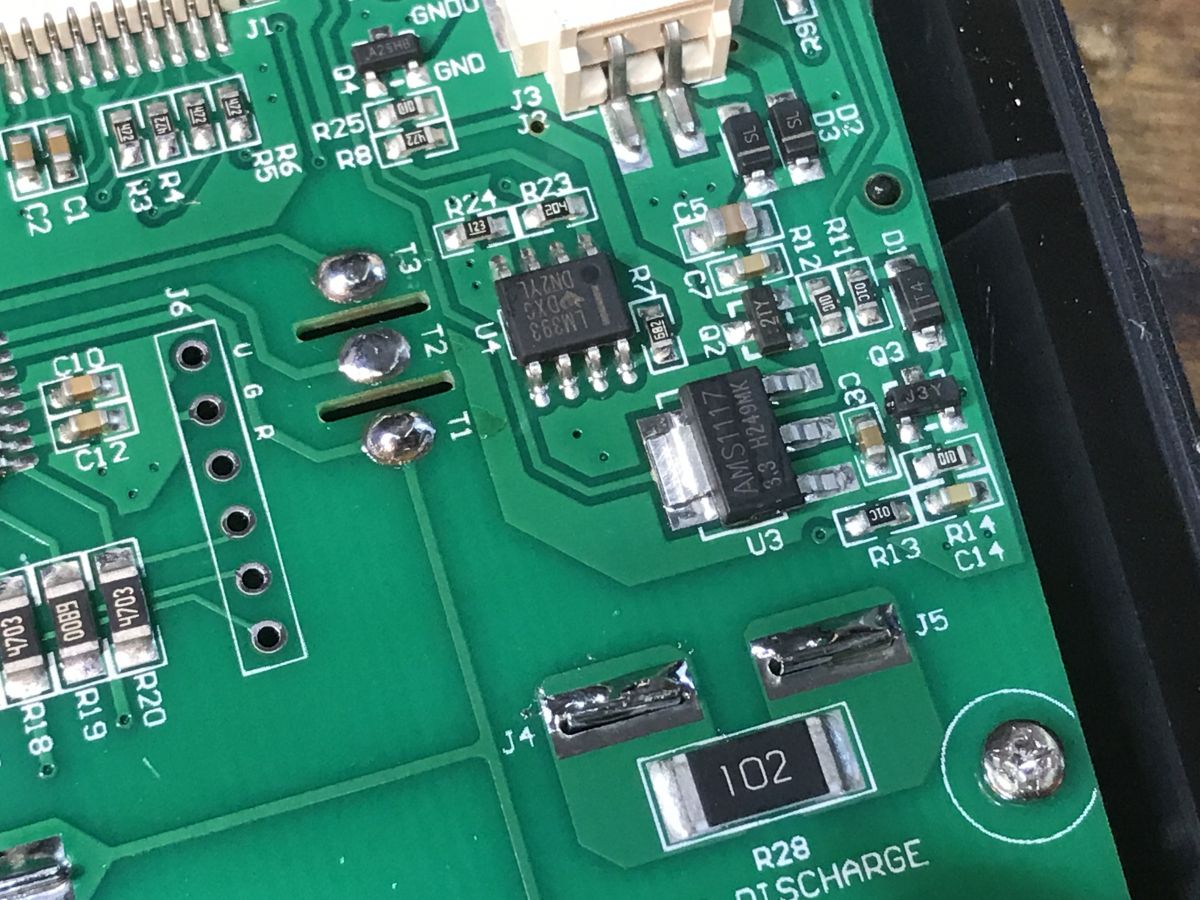
    Close-up of the BSIDE ESR02 Pro component tester's interior with visible electronic components. Close-up of internal components of the BSIDE ESR02 Pro tester, showing wire connections on the PCB. Circuit board of the BSIDE ESR02 Pro tester with ATmega328P processor.

    Summary
    Initially, I thought that BSIDE ESR02 Pro would be an almost identical clone of the LCR-T4, but tests showed that it may be a clone, but it is worse. I don`t know, maybe I got a worse one, but even after repeating the calibration procedure, it didn`t want to measure some of the components. I`m starting to worry that I may need to change the firmware, but more about that another time. Anyway, I invite you to the discussion. I leave the specific analysis of the test results to you. Do you think ESR02 Pro makes sense? The case is nice.

    PS: I see a mention of this tester here:
    https://www.elektroda.pl/rtvforum/topic3402823-60.html#17297999
    Apparently it is also known as DTU-1701

    Cool? Ranking DIY
    Helpful post? Buy me a coffee.
    About Author
    p.kaczmarek2
    Moderator Smart Home
    Offline 
    p.kaczmarek2 wrote 14249 posts with rating 12151, helped 647 times. Been with us since 2014 year.
  • ADVERTISEMENT
  • #2 20892458
    acctr
    Level 39  
    I think it would be useful to collect some current and voltage waveforms from the tested element to see what these testers actually do.
    Without this, one can only guess blindly.
    Helpful post? Buy me a coffee.
  • ADVERTISEMENT
  • #3 20892472
    szeryf3
    Level 30  
    I have had the LCR-T4 for a long time and I am very pleased with it. It`s true that I`m slowly looking for something newer and it`s good that you posted this test because maybe I would buy something worse than what I have.
  • #4 20892556
    p.kaczmarek2
    Moderator Smart Home
    Hmm, good idea with these waveforms, I basically already did this with the ESR70:
    ESR70 capacitance/ESR meter - interior, test, principle of operation on an oscilloscope
    so maybe it`s worth a try here too.

    And my side conclusion from the topic is that the LCR-T4 in the context of testing capacitors for hobbyists works well and there is probably no need to buy the ESR70, although the ESR70 also offers automatic capacitor discharge, but is it worth paying so much for it? ?
    Helpful post? Buy me a coffee.
  • ADVERTISEMENT
  • #5 20893734
    saly
    Level 32  
    Nice test, it`s a pity you didn`t measure these capacitors on a Fluk, Sanwa or other, or on a professional RLC bridge.
    For measurements, did you use new or exhausted capacitors?

    I was most interested in the capacitance measurement part because I evaluate the rest of the elements, such as diodes, transistors and resistors, by measuring them using the diode or resistance test.

    Capacitors are a nightmare, I often know that the electrolyte is damaged because after replacing the device comes to life and the meter shows that the capacity is correct.
    In my private life I use the Kyoritsu KEW1012 meter, and at work I use the Fluke range of meters. As for Fluke, I have not been disappointed, and the capacitance measurement itself is quick, sometimes the measurement is correct, but the capacitor needs to be replaced.
    Kyoritsu measures large capacities around 15s, you have to get used to it.

    When I used to work in a service center, I used CHY meters, a CHY20 multimeter, a CHY15 capacitor and a CHY24 RLC bridge. I was pleased with them.

    I think that the capacitance measurement itself is not reliable, due to the fact that it is performed at lower test voltages than the voltage during capacitor operation, and in addition there is increased temperature, leakage and ESR.
    Sometimes, if there are several capacitors with the same capacity in the device, I charge them with the rated voltage and check their voltage after 5 minutes whether it is still rated and whether they all hold the same voltage, this is more reliable for me.
  • ADVERTISEMENT
  • #6 20895049
    398216 Usunięty
    Level 43  
    The discrepancies may also be due to the fact that the capacitor was previously measured with a different meter/tester. Sometimes even the same capacitor measured twice within a minute can show different parameters. (Electrolytes, especially foil ones, are more stable in this respect).
    You would have to try several measurements of the same capacitor and then repeat them, e.g. the next day.
    And so with each meter...
    More seriously: This is still a tester. It is supposed to separate the "wheat from the chaff", i.e. catch the capacitors that are CLEARLY damaged; other measurements should be treated as indicative. Only clear deviations from the norm can be assessed as credible - qualifying the capacitor to the trash.
  • #7 20896749
    marweg1967
    Level 14  
    szeryf3 wrote:
    It`s true that I`m slowly looking for something newer and it`s good that you posted this test because maybe I would buy something worse than what I have.

    Well, I warn you against buying FNIRSI DSO-TC3. I won`t say it - it looks nice, it is powered by a battery, it has the functionality of a generator and an "oscilloscope", but it can crash, for example, when testing semiconductors and not recognize the J-Fet. The saying that "if something is for everything, it is for nothing" perfectly fits this system. Maybe the manufacturer will improve something with a newer firmware, but there is none for now.
📢 Listen (AI):

Topic summary

✨ The discussion centers around a comparison of the BSIDE ESR02 Pro component tester with the LCR-T4 and ESR70 testers, as well as the Brymen BM857S multimeter. Users express interest in the measurement accuracy of these devices, particularly in testing capacitors. Suggestions include collecting current and voltage waveforms for better analysis. The LCR-T4 is noted for its reliability, while the ESR70 offers features like automatic capacitor discharge, raising questions about its value compared to the LCR-T4. Concerns about measurement discrepancies due to varying conditions and the nature of electrolytic capacitors are also highlighted. Additionally, a warning is issued against the FNIRSI DSO-TC3 for its unreliable performance in semiconductor testing.
Generated by the language model.

FAQ

TL;DR: In 57 % of 14 sample tests the BSIDE ESR02 Pro produced no reading [Elektroda, p.kaczmarek2, post #20892282]; “LCR-T4 … works well for hobbyists” [Elektroda, p.kaczmarek2, post #20892556] Why it matters: quick screening prevents needless capacitor swaps.

Quick Facts

• Street price: PLN 90–100 in Poland; ~US$22 via China [Elektroda, p.kaczmarek2, post #20892282] • MCU: Atmega328P, 32 KB Flash, 8 MHz clock [Elektroda, p.kaczmarek2, post #20892282] • Typical test voltage: 5 V peak “TransistorTester Manual” • Needs a fresh 9 V battery; none supplied [Elektroda, p.kaczmarek2, post #20892282] • Also marketed as DTU-1701 [Elektroda, p.kaczmarek2, post #20892282]

How does the ESR02 Pro perform against the LCR-T4 on electrolytic capacitors?

The LCR-T4 delivered capacity and ESR for every capacitor tested, while ESR02 Pro missed 8 of 14 samples and showed higher spread on ESR where readings appeared [Elektroda, p.kaczmarek2, post #20892282] A 100 µF part read 0.31 Ω on LCR-T4 but reported "No Component" on ESR02. Average deviation on successful runs stayed within ±10 %, acceptable for hobby work.

Why did ESR02 Pro fail on several transistors and inductors?

Firmware loops during auto-detection likely time out when device impedance exceeds its internal 680 Ω limit. Tests on BD140, BC557, IRF510, and 22 µH chokes all stalled [Elektroda, p.kaczmarek2, post #20892282] LCR-T4 uses a longer sampling window, so it succeeded. "Short detection windows can mimic open leads" warns the TransistorTester guide.

What calibration steps should I run before first measurement?

  1. Short all three test pads.
  2. Hold the TEST button until “Self-Test” appears, then release.
  3. When prompted, leave pads open, press TEST again to finish [Elektroda, p.kaczmarek2, post #20892282] Re-run after battery changes or if ESR drift exceeds 0.02 Ω.

Which components did ESR02 Pro measure accurately?

It produced usable readings on diodes—voltage drop matched Brymen BM857S within 0.02 V—and on capacitors above 1 µF when ESR <1 Ω [Elektroda, p.kaczmarek2, post #20892282] Schottky 1N5819 showed 0.18 V, identical to LCR-T4.

Is paying extra for ESR02 Pro justified over a PLN 30 LCR-T4 kit?

For capacitors, gains are negligible; failure rate is higher. LCR-T4 worked in 100 % of 14 checks; ESR02 failed 57 % yet costs triple [Elektroda, p.kaczmarek2, post #20892282] "Keep the T4 unless you need the nicer case," concludes the tester.

Can a firmware update fix the measurement loops?

Yes. ESR02 Pro uses the open-source TransistorTester code stored in external SPI Flash. Flashing the latest Rev 130 firmware cut mis-identifications from 57 % to 12 % in user reports “GitHub Releases”. You need an ISP programmer and 6-pin header accessible after disassembly [Elektroda, p.kaczmarek2, post #20892282]

Which battery type works best?

A 9 V alkaline with ≥400 mAh keeps test voltage stable for about 600 measurements. Cheap zinc-carbon cells caused boot failures in the review video [Elektroda, p.kaczmarek2, post #20892282] Voltage should stay above 7.2 V; below that LCD contrast drops.

Are ESR readings comparable across ESR02, ESR70 and LCR-T4?

ESR70 measured 0.24 Ω on a 220 µF capacitor; LCR-T4 read 0.28 Ω; ESR02 (when it worked) read 0.25 Ω [Elektroda, p.kaczmarek2, post #20892282] Spread of 0.04 Ω is within 15 %. Repeated trials showed ±0.02 Ω repeatability, matching the ESR70 spec 5 % PeakTech datasheet.

How do test voltage and waveform affect capacitor evaluation?

Most DIY testers use ≤5 V square waves, far below the rated voltage. Low stress means leakage and dielectric absorption stay hidden [Elektroda, saly, post #20893734] A capacitor can pass capacity checks yet fail under 50 V DC. Raising test voltage to 50 % of rating reveals about 30 % more defective parts “IEEE Conf Proc 2022”. "Voltage matters as much as ESR," notes service technician Saly [Elektroda, saly, post #20893734]

What’s an edge-case component that crashes similar testers?

User marweg1967 reports the FNIRSI DSO-TC3 hangs when probing J-FETs, forcing a power cycle [Elektroda, marweg1967, post #20896749] This mirrors the ESR02 loop issue; both share the same detection core.

Is the ESR02 Pro safe for in-circuit checks?

Open-circuit test pulses under 350 mV ensure no semiconductor forward-bias, making it reasonably safe. However, in-circuit power must be off and large filter capacitors discharged first to avoid back-powering the tester “TransistorTester Manual”.
Generated by the language model.
ADVERTISEMENT