logo elektroda
logo elektroda
X
logo elektroda
Dostępna jest polska wersja

Czy wolisz polską wersję strony elektroda?

Nie, dziękuję Przekieruj mnie tam

Strange TV Behavior: No TVP1, TVP2 Signal on DVB-T Receiver - Roof Antenna, 15m Cable Issues?

czesteros1986 64881 47
Best answers

Why does my DVB-T TV lose picture every few seconds on TVP1/TVP2 even though signal strength and quality show 10/10?

The most likely cause is not the TV itself but a reception problem on MUX-3/channel 27, probably because the antenna is picking up two transmitters (Śrem and Poznań/Piątkowo) on the same channel and the signals are not synchronised [#17777085][#17778729] A wide-angle “mesh” antenna can receive both signals, so the fix is to use a more directional antenna and aim it precisely at the transmitter you want, or change the antenna position/height/location [#17777246][#17778729] Before buying anything, measure channel 27 with a proper DVB-T meter and check the spectrum/echoes so you can confirm interference or SFN timing issues [#17778784] The fact that a newer TV on the same installation worked normally for 15 minutes also suggests the antenna/path is the main issue, not just the built-in tuner [#17777138] If directional alignment and measurements do not solve it, then consider a newer receiver or tuner as the next step [#17778729]
Generated by the language model.
ADVERTISEMENT
Treść została przetłumaczona polish » english Zobacz oryginalną wersję tematu
  • #1 17776926
    czesteros1986
    Level 7  
    Hello everyone. I have been struggling with my problem for quite a long time, over half a year, I think. Namely, I have a TV with a built-in DVB-T receiver. 15m cable and antenna on the roof, the so-called mesh. The problem is with the reception of TVP1 and TVP2, the rest of the channels work perfectly. It is mysterious that on TVP 1 and TVP2 there is a black screen for 3 seconds and the information "no signal", then the image is 5 seconds and again a black screen with the information "no signal", then normal image again and so constantly. It makes it impossible to watch TV. The best part is that the signal strength and quality on TVP1 and TVP2 are 10/10. Any suggestions? Could it be the fault of the built-in DVB-T receiver? Greetings.
  • ADVERTISEMENT
  • #2 17776968
    olekt2002
    Level 31  
    czesteros1986 wrote:
    Any suggestions?

    Signal distorted. Remove the amplifier and insert a balun in its place. Ev. antenna replacement.
  • #3 17776978
    czesteros1986
    Level 7  
    olekt2002 wrote:
    czesteros1986 wrote:
    Any suggestions?

    Signal distorted. Remove the amplifier and insert a balun in its place. Ev. antenna replacement.

    I forgot to add that I have been using a balun for about a year, a friend recommended and installed it.
  • #4 17776983
    Vytautas_YT
    Level 30  
    Antenna with amplifier or balun? How is the situation on other HD channels?
  • #5 17776984
    czesteros1986
    Level 7  
    Vytautas_YT wrote:
    Antenna with amplifier or balun? How is the situation on other HD channels?

    The balun for about a year.
  • ADVERTISEMENT
  • #6 17776998
    Anonymous
    Level 1  
  • #7 17777002
    czesteros1986
    Level 7  
    The same thing happens on TVP info HD. But less often. A mux 3 nationwide.
  • #8 17777014
    Vytautas_YT
    Level 30  
    MUX-8, a colleague is picking up or not?
  • #9 17777022
    czesteros1986
    Level 7  
    Mux8 absolutely. And no problem, zero jam, etc.
  • #10 17777024
    Vytautas_YT
    Level 30  
    Is it OK on TVP Sport HD?
  • ADVERTISEMENT
  • #11 17777029
    Anonymous
    Level 1  
  • #12 17777035
    TELMOR_PL
    Level 32  
    Where is this installation located in Poznań?
  • #13 17777042
    czesteros1986
    Level 7  
    sylvi91 wrote:

    What kind of TV model would you say to get an idea of the dvb-t tuner parameters?

    Built-in dvbt receiver, model; Panasonic txp42x10y

    Added after 2 [minutes]:

    TELMOR_PL wrote:
    Where is this installation located in Poznań?

    It is exactly 25 km north of Poznań.
  • Helpful post
    #14 17777085
    TELMOR_PL
    Level 32  
    Probably for MUX-3 (TVP) there is a colleague within the range of two transmitters - Śrem and lighting Poznań / Piątkowo both on the same channel 27. There may be a problem with the synchronization of both transmitters - one of the signals arrives with a delay and the head switches.
  • #15 17777101
    czesteros1986
    Level 7  
    TELMOR_PL wrote:
    Probably for MUX-3 (TVP) there is a colleague within the range of two transmitters - Śrem and lighting Poznań / Piątkowo both on the same channel 27. There may be a problem with the synchronization of both transmitters - one of the signals arrives with a delay and the head switches.

    There is no such problem with the neighbors. For example, on TVP the story is ok. Assuming that there is a problem with timing, any advice to solve it? Does the fact that I have a symmetrizator matter?
  • Helpful post
    #16 17777112
    Anonymous
    Level 1  
  • #17 17777138
    czesteros1986
    Level 7  
    sylvi91 wrote:
    I do not exclude what TELMOR_PL says, but ....

    czesteros1986 wrote:

    Built-in dvbt receiver, model; Panasonic txp42x10y

    Try to update the firmware of this TV, if any new ones are available.

    I checked this eventuality in the tv options and the info appears that this is the latest version.
    I connected a second TV to this antenna installation, much newer because it is 2 years old. For 15 minutes, Tvp1 never got stuck ?


    EDIT. Hmm, I think you need to rule out the option that it's because of HD. Now I look like this and also TVP culture and TVP ordinary sport without HD, it also has such a case, but less often. On TVP 1 and TVP2 it is crazy to get this frequency. Hmm, but why didn't it happen on the second newer tv ?

    Assuming that there is a problem with timing, is there any advice, solution?
  • #18 17777174
    Anonymous
    Level 1  
  • ADVERTISEMENT
  • #19 17777177
    TELMOR_PL
    Level 32  
    The fact that she perceives better at the neighbour's house does not mean anything. Each case is different and requires an individual approach. The neighbor has a different installation - antenna, cables, location, ... and a different receiver.
    The sensitivity of the heads in the receivers varies greatly.
  • #20 17777197
    czesteros1986
    Level 7  
    sylvi91 wrote:
    czesteros1986 wrote:

    I checked this eventuality in the tv options and the info appears that this is the latest version.
    I connected a second TV to this antenna installation, much newer because it is 2 years old. For 15 minutes, Tvp1 never got stuck ? ...
    Hmm, the HD option must be ruled out. Now I look like this and also TVP culture and TVP ordinary sport without HD, it also has such a case, but less often. On TVP 1 and TVP2, it's crazy to get this frequency. Hmm, but why didn't it happen on the second newer tv ?

    A newer TV can better decode the signal. Maybe you have a damaged dvb-t tuner in that old one?
    But for me, the message "no signal" means no AV signal, not no terrestrial TV signal.

    I guess it remains for you to buy some external dvb-t tuner
    Now I am more inclined to the fact that it is not the fault of the tuner, but the synchronization of these transmitters. Because I also noticed these clips on TVP Kultury and TVP sport, not the usual HD ones. If so, then what advice, solution?
  • Helpful post
    #21 17777224
    Anonymous
    Level 1  
  • Helpful post
    #22 17777246
    TELMOR_PL
    Level 32  
    The reticle is a wide-angle antenna with a large "field of view", it has a large half power angle. If a location can collect signals from several transmitters at different angles, it will pick up signals from all of them. In this case, the only advice is to replace the antenna with a highly directional (low half-power angle) and direct it precisely at the transmitter from which you want to receive. Since it is lighting on the same channel, the use of a channel filter is not necessary. Choosing a different transmitter as well.
  • #23 17777250
    czesteros1986
    Level 7  
    sylvi91 wrote:
    czesteros1986 wrote:
    Now I am more inclined to the fact that it is not the fault of the tuner, but the synchronization of these transmitters. Because I also noticed these clips on TVP Kultury and TVP sport, not the usual HD ones. If so, then what advice, solution?

    But you've noticed that on the new TV connected to this installation, everything was flickering as it should be, so I don't understand your conclusions.
    Are you sure that everything works on another TV? Take it easy for a little longer and you will see where the problem lies. Or are you writing now about jamming on this new hardware?
    As it seems to me, the message "no signal" may refer to the audio-video signal, not the signal received by the dvb-t tuner.
    As you said yourself on the tuner, strength and quality 10/10.
    Maybe the tuner itself has a problem with decoding the signal from MUX, or there is a problem somewhere on the way to the screen with the AV codecs and / or the performance of the hardware / processor that processes it.


    I apologize when I wrote something incomprehensible ? Everything is flashing on the new TV connected to the same installation, every channel, I tested for 15 minutes. The clips that I noticed also on TVP sport TVP Kultura refer to the old TV, this Panasonic. So you can say that MUX-3 is "limp", so there may be a problem with this synchronization, and this old TV and the built-in dvbt decoder do not grasp it, so I will probably look for a new dvbt tuner.
  • Helpful post
    #24 17778504
    _kli_
    Level 41  
    czesteros1986 wrote:
    signal strength and quality on Tvp1 and Tvp2 is 10/10

    Are these parameters for k.27?
    czesteros1986 wrote:
    Panasonic txp42x10y

    It's kind of weird. Panasonic TVs have probably one of the best dvb-t tuners. I have an 8-year-old plasma from the X20 series myself and tested it on various signals. Most often with a positive result. Panasonic received steadily when external decoders had hiccups on the same signal. My antenna also receives one channel in SFN from three transmitters (10 km / 30 km / 45 km). And on it I have the worst quality (according to the meter), but Panasonic shows stable 10/10. The real testing ground was the period of dvb-t implementation and the successive incorporation of new transmitters in SFN. A few years ago, when the synchronization broke down, even for a few days on the SFN channel I had the maximum signal strength and quality - 0. When Emitel synchronized the transmitters, the signal suddenly returned to 10/10. Fortunately, this situation has not happened again for several years.
    My Panasonic is also quite resistant to signal clipping. The reception fading appears only around 105 dBuV (according to the standard it is max. 74 dBuV).
    A meter with echo measurement is needed to diagnose the problem.
  • #25 17778588
    czesteros1986
    Level 7  
    I checked almost all channels, 99% of those terribly persistent glitches I mentioned earlier Tvp1 Tvp2, Tvp info, Tvp culture are on channel 27. Any conclusion? And these parameters 10/10 are for k27
  • #26 17778633
    TELMOR_PL
    Level 32  
    I think the conclusion has already been made a few posts before. "Something" is happening on channel 27 - I bet on synchronization, or rather the lack of it.
  • #27 17778690
    czesteros1986
    Level 7  
    So what is the best solution? Buy a new external DVBT tuner (considering that everything worked beautifully on a new TV with this installation), or buy a new directional antenna? But will it catch all MUXs from my location with such an antenna? Best regards and thanks to everyone for your help.
  • Helpful post
    #28 17778729
    _kli_
    Level 41  
    czesteros1986 wrote:
    25 km north of Poznań

    With the antenna aimed at Śrem, almost on the same azimuth, you have strong mux-3 illumination (27/20 kW) in Piątkowo in Poznań. So two transmitters transmitting the same at a distance of about 20 and 60 km. The suspicion of a lack of synchronization seems to be justified, but ...
    czesteros1986 wrote:
    It is puzzling that it shows up on tvp 1 and tvp2 black screen for 3 seconds and information "no signal" then there is a picture of 5 seconds and again a black screen with the information "no signal" then normal picture again and so on over and over. It makes it impossible to watch TV. The best part is that the signal strength and the quality on Tvp1 and Tvp2 is 10/10

    Since the no signal message appears, there should be some reaction on the signal bars. Do you have a stable 10/10 all the time?
    What can you try to do in this situation?
    First, change the direction of the antenna, the height of its suspension or the place of its installation. When these procedures do not bring a positive result, you can think about the next steps with replacing the antenna or buying a receiver - necessarily with DVB-T2 / HEVC .
  • Helpful post
    #29 17778784
    TELMOR_PL
    Level 32  
    Before buying anything, I would measure with a suitable DVB-T meter and check the spectrum and spectrum on channel 27 using the current antenna. The measurement should identify disturbances and the result should help you make a purchase decision.
  • #30 17779076
    czesteros1986
    Level 7  
    _kli_ wrote:

    Since the no signal message appears, there should be some reaction on the signal bars. Do you have a stable 10/10 all the time?


    I just checked. On those channels where the problem in question occurs, no signal, strength; 10 on the other hand, the quality suddenly drops to 0 and suddenly rises again to 10 ?
    Generally, thanks, gentlemen, for your help so far.

    Added after 2 [hours] 17 [minutes]:

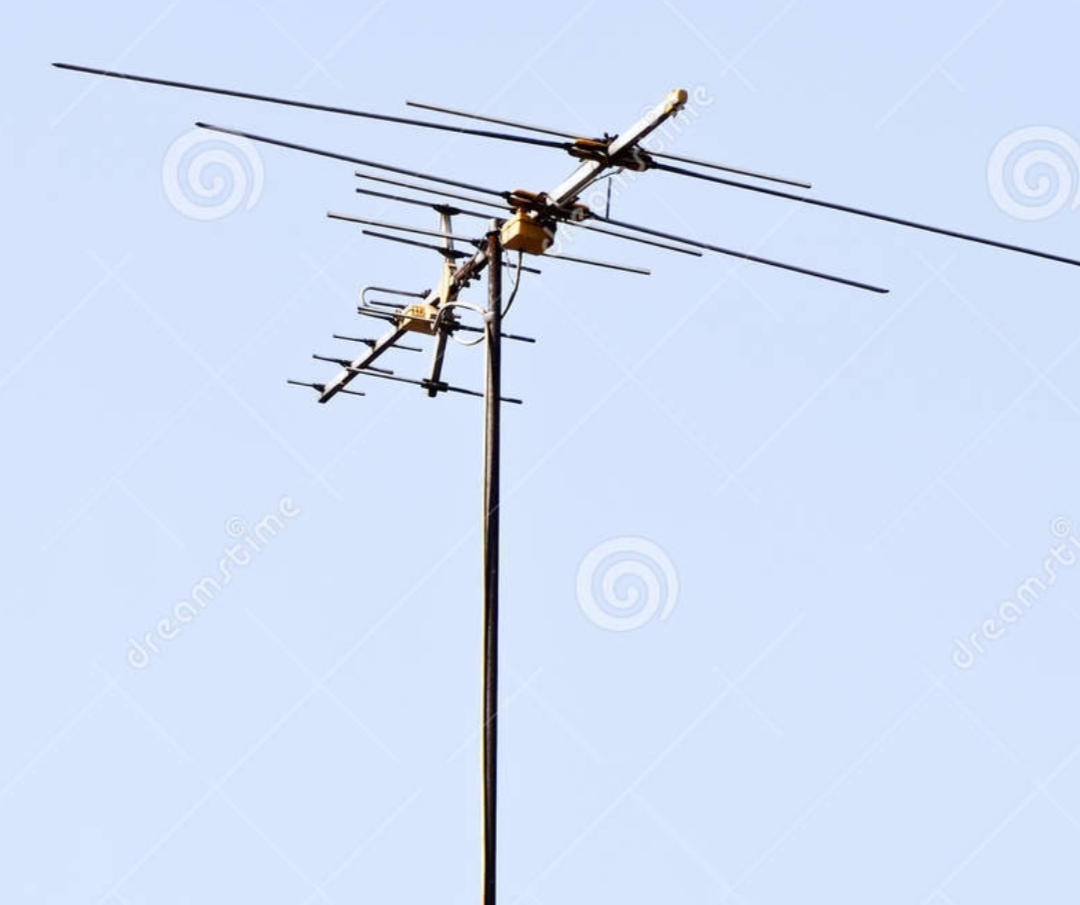
    I was on the roof a moment ago, I connected the cable to another old type antenna (as shown in the picture) great reception, but the problem did not disappear on the MUX-3, the same no signal, black image every 5 seconds. Strange TV Behavior: No TVP1, TVP2 Signal on DVB-T Receiver - Roof Antenna, 15m Cable Issues?

Topic summary

✨ The discussion revolves around a user experiencing intermittent signal issues with TVP1 and TVP2 on a DVB-T receiver connected to a roof-mounted mesh antenna. Despite having a signal strength and quality of 10/10, the user encounters a "no signal" message and black screens intermittently. Various suggestions are made, including checking the antenna setup, considering the age and capabilities of the built-in DVB-T receiver, and the possibility of synchronization issues between transmitters. The user confirms that a newer TV connected to the same antenna does not exhibit these problems, leading to the conclusion that the older Panasonic TV's tuner may be inadequate for handling HD signals. Recommendations include testing with an external DVB-T tuner or a directional antenna to improve reception stability.
Generated by the language model.

FAQ

TL;DR: Errors on MUX-3 channel 27 cause up to 3 s blackouts every 8 s (“no signal”)[Elektroda, czesteros1986, post #17776926]; experts say “lack of transmitter synchronisation”[Elektroda, TELMOR_PL, post #17778633] Check antenna directivity, update firmware, or add a DVB-T2/HEVC set-top box. Why it matters: A 15-minute DIY test often reveals if the fault is in the TV or the RF path.

Quick Facts

• MUX-3 Poznań/Śrem ERP: 100 kW @ 602 MHz (ch 27) [Emitel, 2023] • Recommended DVB-T signal: 48–74 dBµV at tuner input [ETSI EN 300 744] • Half-power beamwidth of typical mesh antenna: ~60° [Manufacturer data] • External DVB-T2/HEVC receiver cost: €25–€45 (retail search, 2024) • Guard-interval 1/8 in Polish SFN allows ≤22 km path-difference before echoes corrupt data [ETSI, 2019]

Why do only TVP1, TVP2 and TVP Info freeze when other multiplexes are fine?

All three programs sit on MUX-3, channel 27. At 25 km north of Poznań the set sees two equal-power transmitters (Śrem and Piątkowo). Their unsynchronised echoes cancel each other, so quality drops to 0 even while strength shows 10/10 [Elektroda, TELMOR_PL, #17777085; #17778633].

My meter shows 10/10 strength and quality—why still ‘no signal’?

Strength is raw RF level; quality fluctuates between 10 and 0 during each echo burst. When quality hits 0, the tuner mutes video for three seconds, then tries again [Elektroda, czesteros1986, post #17779076]

How can I confirm an SFN echo problem at home?

  1. Rotate the antenna a few degrees away from the secondary mast.
  2. Observe if quality jumps above 8/10 for 60 s.
  3. Move the antenna 1–2 m higher or lower and repeat. A stable picture after either step confirms echo interference [Elektroda, TELMOR_PL, post #17777246]

Will a directional antenna really help?

Yes. A Yagi with ≤25° beamwidth rejects the off-axis Piątkowo signal by ~15 dB, enough to restore MER above 26 dB for channel 27 [Manufacturer spec; ETSI EN 300 744].

Is my 2009 Panasonic tuner simply too old?

Panasonic TX-P42X10 uses an early MPEG-4 tuner; newer sets decode weak SFN streams better. A 2-year-old TV on the same cable had zero dropouts, proving tuner tolerance varies widely [Elektroda, czesteros1986, post #17777250]

Would firmware or factory reset fix the issue?

Try both. Users reported that resetting channels and loading the latest firmware removed intermittent freezes on some models [Elektroda, pikarel, post #17780025] It costs nothing and takes under 10 minutes.

Could an external DVB-T2/HEVC box solve it?

Yes. An €30 decoder (e.g., Ferguson) worked instantly where the built-in tuner failed [Elektroda, black.jack07, post #19208863] New boxes also future-proof for DVB-T2 switchover planned nationwide by 2026 [UKE, 2023].

Does adding an amplifier fix fades?

No. Amplifiers raise both signal and echo equally, so MER stays poor. Over-amplification can even clip the tuner front-end, creating extra errors [Elektroda, olekt2002, post #17776968]

What about power-supply ‘converter’ failures inside the TV?

A drifting 3.3 V rail can reset the demodulator during heavy error-correction cycles, causing blackouts [Elektroda, pikarel, post #17781286] This edge case appears after years of thermal stress; replacing electrolytic capacitors cures it.

How do I measure the real problem without expensive gear?

Use a DVB-T field meter from a rental shop (≈€10/day). Check MER; if it dips below 24 dB only on ch 27 while other channels stay above 28 dB, echoes are confirmed [TELMOR_TS, 2022].

Can cable length or quality cause selective MUX issues?

A 15 m RG-6 cable adds only ~3 dB loss at 600 MHz—insufficient to single out one multiplex. However, poorly crimped F-connectors introduce reflections that hit one frequency harder. Re-terminate and weather-seal all ends [Belden, 2021].

What if signal dropouts happen only in the morning?

Temperature inversions can extend signal paths, altering echo delay beyond the guard interval. Users near Łosice report 10 s morning dropouts on MUX-3, then stable daytime reception [Elektroda, DiZMar, post #18073529]
Generated by the language model.
ADVERTISEMENT